<?xml version="1.0" encoding="UTF-8"?>
<feed xmlns="http://www.w3.org/2005/Atom">
    <title>Demon&apos;s Whisper</title>
    <link rel="alternate" type="text/html" href="https://blog.blazingangles.net/wen/" />
    <link rel="self" type="application/atom+xml" href="https://blog.blazingangles.net/wen/atom.xml" />
    <id>tag:blog.blazingangles.net,2011-04-11:/wen//8</id>
    <updated>2018-08-18T14:07:16Z</updated>
    <subtitle>The voices must be obeyed.</subtitle>
    <generator uri="http://www.sixapart.com/movabletype/">Movable Type 6.3.7</generator>

<entry>
    <title>By Their Sins You Shall Know Them</title>
    <link rel="alternate" type="text/html" href="https://blog.blazingangles.net/wen/2018/08/by-their-sins-you-shall-know-them.html" />
    <id>tag:blog.blazingangles.net,2018:/wen//8.2377</id>

    <published>2018-08-18T14:06:23Z</published>
    <updated>2018-08-18T14:07:16Z</updated>

    <summary>If you want to know what kind of people follow a particular religion, don&apos;t study its tenets, its beliefs, its values, or its ethics. Look instead for its sins. Christian sins include gluttony, sexual misconduct, wrath, envy, etc., and you...</summary>
    <author>
        <name>Ole Wolf</name>
        <uri>http://blog.blazingangles.net/soapbox/</uri>
    </author>
    
        <category term="Religion" scheme="http://www.sixapart.com/ns/types#category" />
    
    
    <content type="html" xml:lang="en-us" xml:base="https://blog.blazingangles.net/wen/">
        <![CDATA[<p>If you want to know what kind of people follow a particular religion, don't study its tenets, its beliefs, its values, or its ethics. Look instead for its sins.</p>
<p>Christian sins include gluttony, sexual misconduct, wrath, envy, etc., and you will find no people as fat, perverse, angry, and resentful as Christians. In the Church of Satan, you find the sins of stupidity, counter-productive pride, lack of perspective, etc., and its members invariably behave as if these<span class="text_exposed_show"> sins were virtues. Within Islam, you find sins such as associating anything with Allah, theft, gambling, and backbiting, and I hardly need to mention which behavior comes to mind when you observe muslims.</span></p>
<div class="text_exposed_show">
<p>And so it is: religious sins describe the people that the religion fosters or attracts. If you find cowardice among the list of sins, don't expect a follower of that religion to stand up for you when the going gets tough; if stupidity is a sin, you can safely bet your money that the religion attracts mostly uneducated people; and if lust is a sin, keep a watchful eye on your children if you leave them among followers.</p>
</div>]]>
        
    </content>
</entry>

<entry>
    <title>My switch from gushing bottles to kegging</title>
    <link rel="alternate" type="text/html" href="https://blog.blazingangles.net/wen/2016/04/from-gushing-bottles-to-kegging.html" />
    <id>tag:blog.blazingangles.net,2016:/wen//8.2366</id>

    <published>2016-04-11T10:41:03Z</published>
    <updated>2016-04-11T11:50:33Z</updated>

    <summary>After having brewed beer for a few years, I recently went from bottling to kegging. My reason was defeat. Too many of my batches have turned into gushers when bottled. I once discovered that one batch had become infected when...</summary>
    <author>
        <name>Ole Wolf</name>
        <uri>http://blog.blazingangles.net/soapbox/</uri>
    </author>
    
        <category term="DIY" scheme="http://www.sixapart.com/ns/types#category" />
    
    <category term="beer" label="Beer" scheme="http://www.sixapart.com/ns/types#tag" />
    
    <content type="html" xml:lang="en-us" xml:base="https://blog.blazingangles.net/wen/">
        <![CDATA[<p>After having brewed beer for a few years, I recently went from bottling to kegging.</p>
<p>My reason was defeat. Too many of my batches have turned into gushers when bottled. I once discovered that one batch had become infected when I was about to bottle it, so I assumed that the other gushers had been infected, too. Although, I wasn't entirely certain, because when I managed to vent and pour a gusher, the telltale sourness of an infected beer was absent. The gushing appeared by be caused by the thin layer of sediment in the bottle being whirled up by a few bubbles, becoming a nucleous for additional CO<span style="vertical-align: sub; font-size: 0.9em;">2</span> bubbles and making the beer gush through the bottle neck. This would indicate over-carbonation but for this to be true, apparently the difference between almost flat and over-carbonated beer seemed to be about five to ten grams of sugar for an entire batch, and I found that unlikely.</p>
<p>It also seemed unlikely that boiling sugar dissolved in water for ten minutes, cooling it down, and pouring it into the beer would cause an infection. I had ruled out hygiene problems related to the bottles because I've always cleaned and disinfected the bottles thoroughly, and it was either the same kind of gushing in all 60 to 90 bottles, or nothing at all. (In case you wonder, I also paid proper attention to sterile equipment in all other steps of the bottling process.)</p>
<p>I finally became convinced that infection at bottling time was hardly the reason when my first lambic style beer also became a gusher. It had been sitting in its carboy for a year and a half when I primed it with sugar and new yeast then transferred it bottles. Two weeks later, they were all gushers; not violent ones, but enough to whirl the sediment into the beer and having to rush the beer into a glass. I vented and re-capped them all, and it seems I may be lucky this time. But certainly the gushing could hardly be caused by an infection considering that the beer was deliberately "infected" to begin with and everything edible had long since been digested by the bacteria.</p>
<p>My current hypothesis is that it was probably beer brewed with highly or moderately flocculating yeast that stayed in the bottles; low-flocculation yeast might not settle well enough on the smooth bottom of the bottles, causing just enough of it to be drawn into the beer to start the chain reaction that I'd observed earlier.</p>
<p>Rather than sticking (excuse the pun) to highly flocculent yeast, I figured that since kegged beer is tapped from the bottom of the keg, then even if there's sediment in the keg that provides nucleation particles for the bubbles, it will be flushed out of the keg. Hence, if my hypothesis is correct, my gushing problems should be eliminated by kegging the beer.</p>
<div style="float: right; padding: 10px 10px 0px 10px; margin: 0px 0px 10px 20px; border: 1px solid; width: 280px; text-align: center;"><img style="margin: 5px auto 10px auto; width: 250px;" src="/wen/images/fjerde-rytter.png" alt="Fjerde Rytter" />
<p style="text-align: justify; font-size: 0.8em; font-weight: bold;">&#8220;Fjerde Rytter,&#8221; Danish for &#8220;Fourth Horse­man,&#8221; is the pale rider who brings death: an appro­priate name for an aggres­sively hopped IPA.</p>
</div>
<p>[hyphenate]Maybe my hypothesis is correct, or maybe it is beginner's luck, but my first kegged beer seems to be perfect. The first two glasses tapped from the keg were a muddy mush of sediment, and I was seriously worried about my beer at first, but by the third glass the beer had cleared perfectly, and it tastes wonderful with a perfect head and not a speck of impurity in subsequent servings.</p>
<p>There's lots of information about force-carbonating your beer online and from what I can tell, most of the confusion and mistakes are caused by rather fundamental misunderstanding - like not realizing you should be sitting in your car seat before turning the ignition.<span>[/hyphenate]</span></p>
<p>I nonetheless decided to purchase a complete set containing all the necessary parts: a brand new keg, hoses, a regulator, a CO<span style="vertical-align: sub; font-size: 0.9em;">2</span> canister, and all the necessary fittings. This way I knew I wouldn't be missing anything. Knowing what is needed for a keg, I would know what fittings to order the next time together with a used keg.</p>
<p>So far I've learned two minor things that I didn't see mentioned in any instructions.</p>
<p>Firstly, the set-and-forget force carbonation method means I identify the required pressure on a pressure chart and set the regulator accordingly; it is about as easy as it gets. The keg immediately reaches this pressure, but instead of &#8220;forgetting,&#8221; <em>turn off the gas</em>. Then half a day later as some the CO<span style="vertical-align: sub; font-size: 0.9em;">2</span> is absorbed into the beer, causing the pressure in the little room above the beer to fall, turn the gas back on for a moment to restore the pressure. This needs only being repeated about daily for the first week, then hardly at all after that. The advantage is that you won't lose CO<span style="vertical-align: sub; font-size: 0.9em;">2</span> if there happens to be a small leak somewhere between the CO<span style="vertical-align: sub; font-size: 0.9em;">2</span> inlet and the CO<span style="vertical-align: sub; font-size: 0.9em;">2</span> canister.</p>
<p>Secondly, don't attach the CO<span style="vertical-align: sub; font-size: 0.9em;">2</span> to the beer outlet as some suggest. Granted, the CO<span style="vertical-align: sub; font-size: 0.9em;">2</span> will be absorbed somewhat faster into the beer if it is allowed to bubble up through the beer, but my bet is you'll gain a few hours over an entire week at most. Meanwhile, if you don't maintain CO<span style="vertical-align: sub; font-size: 0.9em;">2</span> pressure, you'll risk beer pushing back into the CO<span style="vertical-align: sub; font-size: 0.9em;">2</span> hose and possibly into the regulator.</p>
<p>Both of the above approaches will reduce the carbonation speed slightly, but if you're serious about speed, probably your best bet is to avoid the set-and-forget method. I'm sufficiently patient to waiting just a few more days. Well, sort of: I couldn't help sampling, of course.</p>
<p>Perhaps I've learned another few things: this particular beer had been sitting in the fermentation bucket for about a month and had stopped fermenting altogether two weeks earlier. It wouldn't have hurt to let it mature a little more, however, so in the future I'll rack my beer to the kegs and have it sit there for another two weeks before applying carbonation. Also, the next beer to be kegged appears to be spiced somewhat too lightly. In contrast to bottled beer, the keg allows me to throw in a little more spice and restore the pressure.</p>]]>
        
    </content>
</entry>

<entry>
    <title>Smoke Detector Just Got Hotter</title>
    <link rel="alternate" type="text/html" href="https://blog.blazingangles.net/wen/2015/09/improved-smoke-detector.html" />
    <id>tag:blog.blazingangles.net,2015:/wen//8.2346</id>

    <published>2015-09-17T15:40:07Z</published>
    <updated>2015-11-25T15:41:43Z</updated>

    <summary>When my wife and I bought our new home after having lived in apartments and thus making other people rich, some of the first electronic equipment was a few smoke detectors. They were inexpensive, visually mostly unobtrusive, deafeningly loud, alerting...</summary>
    <author>
        <name>Ole Wolf</name>
        <uri>http://blog.blazingangles.net/soapbox/</uri>
    </author>
    
        <category term="DIY" scheme="http://www.sixapart.com/ns/types#category" />
    
    <category term="electronics" label="Electronics" scheme="http://www.sixapart.com/ns/types#tag" />
    <category term="hacking" label="Hacking" scheme="http://www.sixapart.com/ns/types#tag" />
    <category term="smokedetector" label="Smoke Detector" scheme="http://www.sixapart.com/ns/types#tag" />
    <category term="xbee" label="XBee" scheme="http://www.sixapart.com/ns/types#tag" />
    <category term="zigbee" label="Zigbee" scheme="http://www.sixapart.com/ns/types#tag" />
    
    <content type="html" xml:lang="en-us" xml:base="https://blog.blazingangles.net/wen/">
        <![CDATA[<p>When my wife and I bought our new home after having lived in apartments and thus making other people rich, some of the first electronic equipment was a few smoke detectors. They were inexpensive, visually mostly unobtrusive, deafeningly loud, alerting each other via radio contact for cross-estate warning, and battery driven.</p>
<p>Well, I said it: battery driven. Battery driven smoke detectors turn into a false sense of security within half a year, because once the batteries run out, you soon learn to forget to change them&#8212;especially in the smoke detectors that were purchased which require three double-A batteries and one 9-volt battery. Besides, were it not for the shelf life of batteries versus gold bars, batteries are so expensive that some countries might consider backing their economies with double-A's rather than gold. So eventually we took down the smoke detectors, probably against any recommendations our insurance company might otherwise have given us.</p>
<p>But then who needs batteries? We have wall outlets in every room, and what is the risk that mains power breaks down during a fire before the smoke detectors manage to warn us? Certainly this risk is smaller than having to remember to change the batteries, perhaps unless you suffer from OCD.</p>
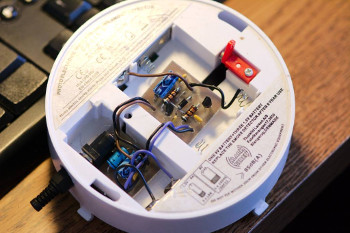
<p><img alt="Smoke Detector with Power Supply" src="/wen/images/smoke-alarm-non-battery.jpg" class="mt-image-right" style="float: right; margin: 0 0 20px 20px;" height="233" width="350" />[hyphenate]Hence, the solution was simple: any electronics tinkerer worth his salt can whip together a power supply, or in the case of our smoke detector, a dual power supply providing 4.5 Volts (corresponding to three double-A batteries) and 9 Volts. A generic 12 Volt wall wart purchased inexpensively over Ebay, coupled with a 78L09 for 9 Volts, followed by a 78L05 and a diode for 4.3 Volts (which is close enough to 4.5 Volts), a few stabilization capacitors, and that was it: solder the output of the voltage regulators to the battery connectors, and our smoke detector would never ask for another battery.[/hyphenate] The dual power supply could probably be crammed into a single battery compartment, but I happened to have a two small pieces of PCB that I had saved. I hate to throw stuff away.</p>

<p>I was just about to install the improved smoke detector when I realized that smoke detectors are no good if you're away from your house. We already have a network of Zigbee devices scattered throughout our garden for measuring our greenhouse environment, the weather, and radiation level. The Zigbee devices report to a Linux server that is permanently turned on, so it only seemed natural to include a Zigbee radio in the smoke detector so that our server could pick up any warnings and act accordingly (that is, by sending a text message to my wife telling her that the dinner I'm preparing is getting ready).</p>
<p>The "XBee" Zigbee module from Digi is capable of detecting pin changes and sending a pin change notification to another XBee module without any additional electronics. Surely the electronics in the smoke detector would include a signal that indicated the detection of smoke, so it was just a question of locating it, preferably before going deaf while the alarm was sounding.</p>
<p><img alt="Smoke Detector's KD-8510 Microcontroller" src="/wen/images/smoke-detector-kd-8510.jpg" class="mt-image-left" style="float: left; margin: 0 20px 20px 0;" height="183" width="250" />[hyphenate]Fortunately, an obscure German discussion revealed that the on-board microcontroller was an otherwise non-descript KD-5810 half-hidden beneath a metal cover, and someone with little electronics experience seemed to have concluded that pin 7 on the processor went high when the detector was triggered. Right indeed; this&#8212;and an additional 3.3 V power supply and a voltage divider to safely feed the 9 V signal on pin 7 to the XBee module&#8212;was all I needed.[/hyphenate] The smoke detector now sits happily on the ceiling in our kitchen, and its companions will be mounted as soon as I have constructed power supplies for them as well. It will not be necessary to put Zigbee radios in the remaining smoke detectors, assuming they will are capable of maintaining their native radio contact with each other.</p>

<p><img alt="Improved Smoke Detector Mounted" src="/wen/images/ceiling_smoke_detector.jpg" class="mt-image-center" style="text-align: center; display: block; margin: 0 auto 20px;" height="352" width="515" />Yes, I know: it is not too pretty yet. The wire should be hidden beneath (well, above) a wire cover, and the antenna should be white. But it works for now.</p>
<p>I have two spare <a target="_self" title="Spark Core" href="https://www.particle.io/">Spark Cores</a> and I briefly considered using one of those instead. However, I have already built a Zigbee infrastructure, and since I also needed more Zigbee routers to keep the network up, Zigbee became the obvious choice.</p>]]>
        
    </content>
</entry>

<entry>
    <title>Non-Absolutism</title>
    <link rel="alternate" type="text/html" href="https://blog.blazingangles.net/wen/2015/02/non-absolutism.html" />
    <id>tag:blog.blazingangles.net,2015:/wen//8.2339</id>

    <published>2015-02-24T20:42:58Z</published>
    <updated>2015-02-24T20:47:48Z</updated>

    <summary>If anyone would ever deny absolutism, it would be the Devil. After all, the Devil refuses to acknowledge God&apos;s omnipresence and omnipotence, and considering the so-far unsuccessful battle of his &quot;good&quot; versus the Devil&apos;s &quot;evil,&quot; evidence does suggest that the...</summary>
    <author>
        <name>Ole Wolf</name>
        <uri>http://blog.blazingangles.net/soapbox/</uri>
    </author>
    
        <category term="Philosophy" scheme="http://www.sixapart.com/ns/types#category" />
    
    
    <content type="html" xml:lang="en-us" xml:base="https://blog.blazingangles.net/wen/">
        <![CDATA[If anyone would ever deny absolutism, it would be the Devil. After all, the Devil refuses to acknowledge God's omnipresence and omnipotence, and considering the so-far unsuccessful battle of his "good" versus the Devil's "evil," evidence does suggest that the Devil has a point: there is room for the Devil's alternative and thus presumably other alternatives as well.<br /><br />

The Devil sides strongly with mankind: He considers all religion to be man-made, able to be shaped and formed according to man's desires and opinions. Like the divine idols of wood, clay, or metal, no god nor law is eternal; every statue and statute may be destroyed or reformed as is seen fit by the same hands that crafted them.<br /><br />

History proves the Devil right. Every religion and every ideal has either changed to keep up with human evolution or has died trying. No ideal has ever stood sure, and no ideal ever will. Every law, culture, and ideal was invented by humans and reached through human conflict and consensus, and has steadily adapted to always model contemporary human desires for a preferred social direction. What was once freedom and liberty may have become enslavement and subjection, and customs have continuously been banned, emerged, or rediscovered.<br /><br />

Even so-called "absolutes" have always been confined within time and reach; for example, "freedom of speech" is only allowed within the limits of the law, which is itself dynamic and always subject to corruption or remedy&mdash;depending on the point of view. To claim that freedom of speech, or any other principle, is absolute is to claim that freedom of speech is beyond human decision. It is a belief in divine power, and the Devil refuses such views.]]>
        
    </content>
</entry>

<entry>
    <title>Beer Fermentation Climate Box</title>
    <link rel="alternate" type="text/html" href="https://blog.blazingangles.net/wen/2014/10/beer-fermentation-climat-closet.html" />
    <id>tag:blog.blazingangles.net,2014:/wen//8.2336</id>

    <published>2014-10-14T13:36:15Z</published>
    <updated>2015-11-25T13:14:40Z</updated>

    <summary>My thirst for beer and my thirst for knowledge seem to be converging these months: I&apos;m gaining interest in brewing beer that I don&apos;t even particularly like but nonetheless feel compelled to try to brew because it poses a technical...</summary>
    <author>
        <name>Ole Wolf</name>
        <uri>http://blog.blazingangles.net/soapbox/</uri>
    </author>
    
        <category term="DIY" scheme="http://www.sixapart.com/ns/types#category" />
    
    <category term="beer" label="Beer" scheme="http://www.sixapart.com/ns/types#tag" />
    <category term="doityourself" label="Do It Yourself" scheme="http://www.sixapart.com/ns/types#tag" />
    
    <content type="html" xml:lang="en-us" xml:base="https://blog.blazingangles.net/wen/">
        <![CDATA[<div>My thirst for beer and my thirst for knowledge seem to be converging these months: I'm gaining interest in brewing beer that I don't even particularly like but nonetheless feel compelled to try to brew because it poses a technical challenge. Recently this manifested itself as a desire to brew a lager which requires equipment that I didn't have at the moment.</div>
<div></div>
<p><img alt="Beer brewing climate box from the outside." src="/wen/images/climate-box-outside.jpg" width="350" height="336" class="mt-image-right" style="float: right; margin: 0 0 20px 20px;" /></p>
<div>[hyphenate]Lagers ferment at rather low temperatures and home brewers generally solve the problem by converting an electric fridge to maintain stable temperatures slightly above their intended operating range. Some brewers implement this conversion somewhat crudely with a control that turns on and off the mains supply for the fridge; others replace the entire control circuitry with a PID controller of their own.[/hyphenate]</div>
<div></div>
<div>I was somewhat concerned about the energy consumption of yet another fridge in our home, however, and decided to ally with the cold climate of Scandinavia instead. I realized that the temperature in our unheated garage is largely the same as the outside temperature, and the average fall or spring temperatures are perfect for lager fermentation.</div>
<div></div>
<div>
<div>The original lagers were carried into the limestone caves of southern Germany where the temperature remains constant through the changing seasons. My garage is no limestone cave, though, and the temperature certainly isn't constant. This poses an immediate problem because beer requires a correct, <i>constant</i> temperature, not a correct, <i>average</i> temperature. Yeast requires a rather stable temperature for its own health reasons, and it produces different byproducts at different temperatures, rendering the quality of the final beer about as unpredictable as the notoriously volatile Danish weather. Placing the fermentation bucket in the garage during the Danish fall or spring might yield a genuine and decent lager but the result would be neither predictable nor repeatable.</div>
<div></div>
<div>Besides, fridges cool their contents but they don't heat them. The fridge would certainly be capable of keeping the temperature down while the outside was too hot, but the beer would be at the mercy of the elements once the outside temperature dropped below the target. Finally, I'm told that fridges and freezers are manufactured for optimum performance at indoor temperatures. It would seem that a fridge would be happy in cool or cold surroundings but its efficiency would actually drop if moved outside of kitchen temperature surroundings.</div>
<div></div>
<img alt="Beer brewing climate box, inside view." src="/wen/images/climate-box-inside.jpg" width="350" height="274" class="mt-image-left" style="float: left; margin: 0 20px 20px 0;" />
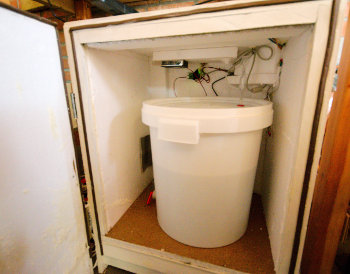
<div>[hyphenate]I decided to take a different route and construct a climate box from scratch. It was not intended to heat or cool its contents but simply maintain a stable temperature over a few days of varying outside temperatures. In other words, a climate box.</div>
</div>
<div></div>
<div>
<div>Thinking about it, maybe my real motivation is that the IT business is entirely uninterested in electronics degrees (and, indeed, in any skill beyond entry-level and hence low salary .NET skills, it seems) which in turn is woefully under-stimulated and hence drives me to use my hard-earned university degree for hobby projects instead. At least someone benefits from my efforts this way; I still regret having been involved in surveillance projects tapping into phones in the Middle East.[/hyphenate]</div>
<div></div>
<div>I constructed the box entirely out of pieces of scrap wood that had been left over after other home projects and was waiting only for my wife or myself to make the next trip to the recycling center. I covered the inside of it with polystyrene and added a wooden floor for the fermentation bucket to stand on. The wooden construction would certainly have been easier with wood that simply needed to be cut into shape rather than being glued together to form sides, but at least this way it was free.</div>
<div></div>
<img alt="Lauter tun made from a food cooler box." src="/wen/images/lauter-tun.jpg" width="300" height="199" class="mt-image-right" style="float: right; margin: 0 0 20px 20px;" />
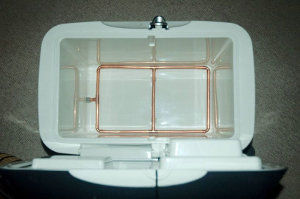
<div>[hyphenate]I then purchased an inexpensive 12 V food cooling box in an automobile parts store where it was on sale now that summer was over. I immediately took it apart to salvage the cooler which I knew was a Peltier element. (I turned the box itself into a lauter tun that I have little use for, but that's beyond the scope of this article.)[/hyphenate]</div>
</div>
<div>
<div></div>
<div>For heating, I had a spare ceramic heater otherwise intended for our reptilian pets. I suppose I could have build some reversible fan mechanisms and valves to allow the Peltier element to be used for both heating and cooling, but I decided to focus on keeping the climate box insulated.</div>
<div></div>
<div>All that remained was a controller, which again i managed to construct entirely out of components that I already had in my electronics lab. The heart of the controller is an Arduino with a custom shield containing a temperature probe and drivers for the Peltier element and the 230 V ceramic heater.</div>
<div></div>
<div>The Arduino uses separate PID controllers for the cooler and the heater. I decided to leave a grant zone where PID controllers would be turned off to curb their opposed interests somewhat. PID controllers, as we know, are rather aggressive and having two PID controllers combat each other would probably throw the entire universe into a state of chaos before eventually reaching a stable temperature of 21 degrees Celsius which isn't suited for lagers.</div>
</div>
<div></div>
<div>
<div>You can download the EAGLE schematic and board layout and the Arduino code here: <a href="/wen/downloads/climate-box.zip">climate-box.zip</a>. The PCB is double-sided but has been designed so that a single-sided PCB is readily possible using just a handful of bridges. Remember to put the voltage regulator and the switching transistor onto heat sinks which should be mounted outside of the climate box for obvious reasons. Or just do as I did: use a regulated power supply, short the voltage regulator, and use a relay instead of the switching transistor. The code is currently modified to be gentle on the relay.</div>
<div></div>
<div>I extended the Arduino's USB to the outside of the climate box which proved useful for tuning the PID controllers. The USB output also allows me to log the temperature development in the climate box.</div>
<div></div>
</div>
<div><img alt="Beer label for &quot;Lektor Blommes maltbolche&quot;." src="/wen/images/lektor-blommes-maltbolche.png" width="250" height="360" class="mt-image-right" style="float: right; margin: 0 0 20px 20px;" />
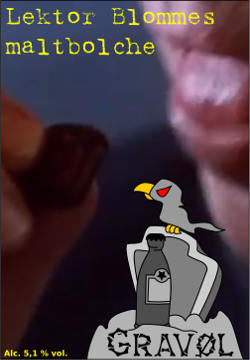
<div>[hyphenate]My first lager beer, which is currently maturing (and "evaporating" at a disconcerting rate because of occasional tasting) in the climate box, will be labeled "Lektor Blommes maltbolche," which is hard to translate as it involves a triple pun. Quite literally, it means "Teacher Blomme's malt candy." The first pun is that "blomme" (the teacher's last name) means "plum" and the beer contains about four kg of beach plums from my garden. The second pun, also on "Blomme," is a reference to my brewery's morbid theme (which will be explained shortly) and requires Danish schooling because any Danish school child has read the book: "Det forsømte forår" ("<a href="https://www.amazon.com/dp/0940242001?tag=whsth-20&amp;camp=14573&amp;creative=327641&amp;linkCode=as1&amp;creativeASIN=0849316545&amp;adid=00Z67QCFJ48AY2QB8CED&amp;">Stolen Spring</a>") by renowned Danish author <a href="http://en.wikipedia.org/wiki/Hans_Scherfig">Hans Scherfig</a>. One of the prominent characters in the book, the sadistic teacher C. Blomme, is poisoned with a malt candy, and since malt is the major ingredient in beer, this constitutes the third albeit weak pun. The beer label shows the scene where Blomme eats the poisoned candy.[/hyphenate]</div>
</div>
<div>
<div>A small Peltier element is rather little for a climate box featuring an entire bucket of fermenting beer, in part because fermenting beer is an exothermic process. The Peltier element seemed capable of counteracting the heat produced by the fermentation, but I had not expected the temperatures to be as high this fall as they turned out to be (<a href="http://www.salon.com/2014/10/13/attention_deniers_earth_just_had_its_hottest_september_ever_recorded/">everywhere</a>, as it turns out). The climate box couldn't quite keep up with temperatures that were consistently above the target temperature so the beer was fermenting at about 12 degrees Celsius when the temperature should have been about 10 degrees Celsius. It remained mostly stable and within the yeast's preferred range, however, which suffices for my purposes. It seems that global warning may be preventing me from brewing lager except in the coldest winter.</div>
</div>
<div>
<div>My home brewery is named "Gravøl," which means "Funeral Beer." It has multiple meanings. Firstly, I began brewing while I was trying to recover from a severe depression and the suicidal reference is gallows humor. Secondly, my fondness of hard-core heavy metal prompted me to tip my hat at the morbid universe of the death metal genre. Thirdly, as indicated with a five-pointed star on my brewery logo's beer label, and in concert with a gloomy theme, I firmly believe that the Devil is highly <a href="../../2011/04/a-tribute-to-the-devil.html">overdue for recognition</a>. With a single exception&#8212;a tribute to one of my favorite politicians that he and his party fortunately enjoyed tasting&#8212;all of my beer has been named with somber references, the above-mentioned beer being no exception.</div>
<div>Granted, I haven't even attempted to calculate how much energy the climate box saves compared to a fridge, or even if it saves energy at all. But hey, it was home made, and the beer tastes, well, like a lager with a distinct plum flavor.</div>
</div>]]>
        
    </content>
</entry>

<entry>
    <title>UV Exposure Box</title>
    <link rel="alternate" type="text/html" href="https://blog.blazingangles.net/wen/2013/03/uv-exposure-box.html" />
    <id>tag:blog.blazingangles.net,2013:/wen//8.2330</id>

    <published>2013-03-30T21:47:59Z</published>
    <updated>2015-11-25T15:57:26Z</updated>

    <summary> Data General Nova 3 printed circuit board, owned by Emil Sarlija. (Photo credit: Wikipedia) When your printed circuit boards (PCBs) become a little too complicated to draw by hand, or when you realize that schematics and PCB capturing is...</summary>
    <author>
        <name>Ole Wolf</name>
        <uri>http://blog.blazingangles.net/soapbox/</uri>
    </author>
    
        <category term="DIY" scheme="http://www.sixapart.com/ns/types#category" />
    
    <category term="doityourself" label="Do It Yourself" scheme="http://www.sixapart.com/ns/types#tag" />
    
    <content type="html" xml:lang="en-us" xml:base="https://blog.blazingangles.net/wen/">
        <![CDATA[<div class="zemanta-img mt-image-right" style="margin: 1em; display: block; float: right; width: 310px;"><a href="http://commons.wikipedia.org/wiki/File:Dg-pcb.jpg"><img class="zemanta-img-configured" src="https://upload.wikimedia.org/wikipedia/commons/thumb/1/14/Dg-pcb.jpg/300px-Dg-pcb.jpg" alt="Data General Nova 3 printed circuit board, own..." height="200" width="300" /></a>
<p class="zemanta-img-attribution" style="font-size: 0.8em;">Data General Nova 3 printed circuit board, owned by Emil Sarlija. (Photo credit: <a href="http://commons.wikipedia.org/wiki/File:Dg-pcb.jpg">Wikipedia</a>)</p>
</div>
<p>When your printed circuit boards (PCBs) become a little too complicated to draw by hand, or when you realize that schematics and <a class="zem_slink" href="http://en.wikipedia.org/wiki/Printed_circuit_board" title="Printed circuit board" rel="wikipedia">PCB</a> capturing is quite easy using <a class="zem_slink" href="http://en.wikipedia.org/wiki/Computer-aided_design" title="Computer-aided design" rel="wikipedia">CAD</a> tools such as <a href="http://www.cadsoftusa.com/eagle-pcb-design-software/">Eagle</a>, you soon learn that the next challenge is how to transfer the PCB layout to the raw PCB copper board.<br /><br />There are many tutorials on that on-line, which all boil down to three steps:<br /><br /></p>
<ol>
<li>Print the PCB onto paper using a laser printer. You'll have to experiment with various paper types and number of times you need to print on top of the same image in order to get enough ink.</li>
<li>Push the printed circuit board layout against the PCB while heating it, typically using an iron or a laminator. You'll have to experiment with heat and pressure.</li>
<li>Somehow peel off the paper without tearing the PCB tracks off. Depending on the type of paper, you'll have to soak it in water for some time, or you'll have to carefully peel off the paper little by little.</li>
</ol>
<p>Unfortunately, even after many experiments, I've found that the results were less than adequately predictable. I'm not patient enough to go through retries or toasted PCBs. The good thing is that photo printing is so easy it can hardly fail. The major advantage of photo PCBs is repeatability and possibly a higher resolution PCB tracks, although I've heard people talk about being able to produce sub 10 mils PCB tracks using the paper transfer method.<br /><br />Photo printing involves three steps, too:<br /><br /></p>
<ol>
<li>Print the PCB layout onto transparent film. Virtually all laser printers can do that. One print will probably suffice.</li>
<li>Put the transparent film on top of a photo-prepared PCB (you can buy those) and expose with UV light for about five minutes.</li>
<li>Develop the PCB.</li>
</ol>
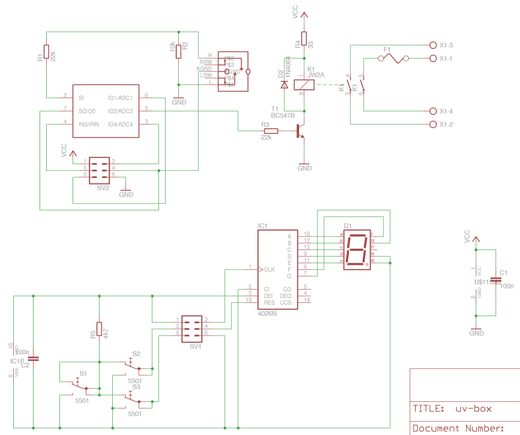
<p>Developing is much like etching: put the exposed PCB into a chemical solution until the tracks are clear, and that's it. UV exposure is also easy: put an UV lamp over the PCB and turn it on for a couple of minutes, then turn it off. You'll probably want to have it inside of a box to avoid looking at it.<br /><br />And now that you have the box, you might also want a timer, preferably an electronic one. The following schematic is an example of making an easy digital timer that allow you to set the exposure time from one to nine minutes.<br /><br />The design revolves around the PICAXE 08M. You may need to alter the code a bit for the newer 08M2, which is faster, so that the timing loop is repeated several more times. The schematic is quite simple (click the image for a larger version):<br /><br /><a href="http://blog.blazingangles.net/wen/assets_c/2013/03/uv-box-schematic-974.html" onclick="window.open('https://blog.blazingangles.net/wen/assets_c/2013/03/uv-box-schematic-974.html','popup','width=1024,height=857,scrollbars=no,resizable=no,toolbar=no,directories=no,location=no,menubar=no,status=no,left=0,top=0'); return false"><img src="https://blog.blazingangles.net/wen/assets_c/2013/03/uv-box-schematic-thumb-520x435-974.png" alt="UV Box Schematic" class="mt-image-center" style="text-align: center; display: block; margin: 0 auto 20px;" height="435" width="520" /></a>The PICAXE 08M uses two outputs for the display, two inputs for three buttons, and one output for a relay which turns on or off the UV lamps. Otherwise, the PICAXE 08M is connected to a programming socket through a few resistors as suggested in the PICAXE Basics manual.<br /><br />The three buttons are used to set the timer value: one for incrementing the value, one for decrementing the value, and one for starting the timer. Any of the keys can be used to shut off the lamp prematurely.<br /><br />The up and down button, S2 and S3, are pulled up, so that a "low" value of the corresponding pin on the PICAXE 08M implies that the particular buttons is pressed. The third button, S1, pulls both buttons to ground, so that it seems as if they're both pressed at the same time. This tells the PICAXE 08M that the "start" button has been pressed.<br /><br />The timer value is displayed on a 7-segment LED display using just two signals: one signal resets a 4026 counter (which outputs its value in 7-segment format, and is capable of driving a 7-segment display), and another signal counts the 4026 one count up. By resetting and quickly counting, any value from 0 to 9 is displayed with only a slight blink in the display.<br /><br />The code for the timer is as follows:<br /><br /></p>
<pre style="font-size: 0.8em;">' UV Box Exposure Timer<br /><br />#picaxe 08m<br />#com /dev/ttyUSB0<br /><br />' Preload the EEPROM with defaults:<br />' Value: Last exposure time. Default is 7 minutes.<br />eeprom 0, ( 7 )<br /><br /><br />' Pin 0: Reset 4026-based 7-segment counter.<br />' Pin 1 and pin 3: Button input (00=none, 01='down', 10='down',<br />'                  11='start'/'stop').<br />' Pin 2: UV lamp on/off.<br />' Pin 4: Count a 4026-based 7-segment counter.<br />input 1, 3<br />output 0, 2, 4<br /><br />symbol i = b0<br />symbol exposuretime = b1<br />symbol digit = b2<br />symbol button1 = b3<br />symbol buttonvalue = b4<br />symbol minutesleft = b5<br />symbol minutecounter = w3 ' b6:b7<br /><br />' Turn off the UV lamp.<br />low 2<br /><br />' Restore the settings from EEPROM.<br />read 0, exposuretime<br />' Display the exposure time<br />let digit = exposuretime<br />gosub showdigit<br /><br />main:<br />    ' Wait for the user to push start. Meanwhile, scan for<br />    ' up and down buttons.<br />    gosub scanbuttons<br />    if buttonvalue = 1 then<br />        gosub countdown<br />    else if buttonvalue = 2 then<br />        gosub countup<br />    else if buttonvalue = 0 then<br />        ' Write the exposure time to EEPROM.<br />        write 0, exposuretime<br />        gosub expose<br />        ' Restore the display.<br />        let digit = exposuretime<br />        gosub showdigit<br />    endif<br />    pause 150<br />    goto main<br /><br /><br />' Expose PCB.<br />expose:<br />    ' Turn on the UV lamp.<br />    high 2<br />    ' Wait half a second to give the user time to release<br />    ' the key.<br />    pause 500<br />    let minutesleft = exposuretime + 1<br />    let digit = exposuretime<br />exposeminute:<br />    gosub showdigit<br />    ' Loop counts in tenths of seconds, and compensate for<br />    ' some loop overhead.<br />    let minutecounter = 590<br />exposeloop:<br />    ' If the user presses a key, then turn off the lamp and<br />    ' return to the main loop.<br />    gosub scanbuttons<br />    if buttonvalue &lt;&gt; 3 then goto endexposure<br />    pause 99<br />    dec minutecounter<br />    if minutecounter &gt; 0 then goto exposeloop<br />    ' Count down the number of minutes left.<br />    dec digit<br />    dec minutesleft<br />    if minutesleft &gt; 1 then goto exposeminute<br />endexposure:<br />    ' Wait half a second to give the user time to release<br />    ' the "stop" (start) key.<br />    low 2<br />    if buttonvalue = 0 then<br />        pause 500<br />    endif<br />    return<br /><br /><br />' Scan the buttons to see if one of them is pressed.<br />' buttonvalue = 0: both pressed,<br />' buttonvalue = 1: button 2 pressed,<br />' buttonvalue = 2: button 1 pressed,<br />' buttonvalue = 3: none pressed.<br />scanbuttons:<br />    let buttonvalue = pin1 * 2 + pin3<br />    return<br /><br /><br />' Increment the exposure time.<br />countup:<br />    inc exposuretime<br />    if exposuretime &lt; 10 then goto displaynewexposure<br />' Decrement the exposure time.<br />countdown:<br />    dec exposuretime<br />    if exposuretime &lt; 1 then<br />        exposuretime = 1<br />    endif<br />displaynewexposure:<br />    digit = exposuretime<br />    gosub showdigit<br />    return<br /><br /><br />' Show the value of "digit" by resetting the display and<br />' counting to the display value.<br />showdigit:<br />    ' Reset the counter.<br />    pulsout 0, 1 ' 10 us pulse<br />    ' Count to the display value.<br />    if digit = 0 then endshow<br />    for i = 1 to digit<br />        pulsout 4, 1 ' 10 us pulse<br />    next i<br />endshow:<br />    return</pre>
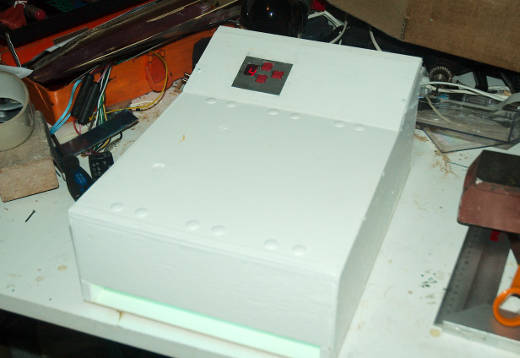
<p><br />The code should be mostly self-explanatory. Refer to the in-code comments for details.<br /><br />The PCB is laid out in two parts, as indicated by the schematic; one for the "main board," which includes the processor and the relay, and one for the user interface, which includes the display and the keys, ready to be mounted in a plate:<br /><br /><a href="/wen/images/uv-box-pcb.png"><img alt="PCB for UV Exposure Box" src="/wen/assets_c/2013/03/uv-box-pcb-thumb-520x632-977.png" class="mt-image-center" style="text-align: center; display: block; margin: 0 auto 20px;" height="632" width="520" /></a>The PCB is single-layer, so the routing is somewhat convoluted. The two "top layer tracks" are easily added as jumpers instead of going through the additional effort of creating a double sided PCB.<br /><br />I won't get into detail about how I obtained the three UV tubes used in the exposure box and how they're connected, because obtaining the UVB tubes cheaply from a local supplier was a bit of luck, and the tubes are wired like any other <a href="http://www.circuitstune.com/2012/01/fluorescent-light-wiring-diagram-tube-light-circuit.html">tube with ballast and starter</a>. The final version in a wooden box looks like this on a somewhat messy workbench:<br /><br /><img alt="UV Exposure Box" src="/wen/images/uv-exposure-box.jpg" class="mt-image-center" style="text-align: center; display: block; margin: 0 auto 20px;" height="358" width="520" />The required exposure time for a photo print is about four to five minutes using this exposure box.<br /><br /><a class="zemanta-pixie-a" href="http://www.circuitstune.com/2012/01/fluorescent-light-wiring-diagram-tube-light-circuit.html" title="Enhanced by Zemanta"><img style="border: none; float: right;" class="zemanta-pixie-img" src="https://img.zemanta.com/zemified_e.png?x-id=88ea979c-8a12-4ea9-b65c-8e0978953dc9" alt="Enhanced by Zemanta" /></a></p>]]>
        
    </content>
</entry>

<entry>
    <title>Sixth Sense</title>
    <link rel="alternate" type="text/html" href="https://blog.blazingangles.net/wen/2011/11/sixth-sense.html" />
    <id>tag:blog.blazingangles.net,2011:/wen//8.2312</id>

    <published>2011-11-23T16:45:43Z</published>
    <updated>2015-11-25T16:01:18Z</updated>

    <summary> Image by Edwin1710 via Flickr. [hyphenate]There is little left to mysticism in martial arts today, with perhaps one very persistent exception: the concept of &quot;chi&quot; or &quot;qi&quot;, depending on language. Qi is not recognized by the scientific community, mostly...</summary>
    <author>
        <name>Ole Wolf</name>
        <uri>http://blog.blazingangles.net/soapbox/</uri>
    </author>
    
        <category term="Realism" scheme="http://www.sixapart.com/ns/types#category" />
    
    <category term="martialarts" label="Martial Arts" scheme="http://www.sixapart.com/ns/types#tag" />
    <category term="science" label="Science" scheme="http://www.sixapart.com/ns/types#tag" />
    
    <content type="html" xml:lang="en-us" xml:base="https://blog.blazingangles.net/wen/">
        <![CDATA[<div class="zemanta-img mt-image-right" style="margin: 1em; display: block; float: right; width: 350px;"><a href="http://www.flickr.com/photos/44385440@N00/493603950"><img class="zemanta-img-configured" src="https://farm1.static.flickr.com/191/493603950_5b141f0437.jpg" alt="martial arts" width="350" /></a>
<p class="zemanta-img-attribution" style="font-size: 0.8em;">Image by <a href="http://www.flickr.com/photos/44385440@N00/493603950">Edwin1710</a> via Flickr.</p>
</div>
<p>[hyphenate]There is little left to mysticism in martial arts today, with perhaps one very persistent exception: the concept of "<a href="http://en.wikipedia.org/wiki/Ch%27i">chi</a>" or "qi", depending on language. Qi is not recognized by the scientific community, mostly owing to the fact that there are no measurable or otherwise objectively observable features that reveal this "force" despite its alleged ubiquity and importance to human interaction and development. There is good reason for skeptics and scientists alike to laugh scornfully at anyone claiming to be able to harness qi. The burden of proof lies on those who claim that qi exists.[/hyphenate]<br /><br />I fit squarely within the group of skeptics, and that leaves me somewhat torn. One one hand, I agree that qi should be discarded and left among the other lumber and wreckage of dead gods and dead philosophies that have proven by results to be empty fiction. On the other hand, I react to qi during my martial arts training, and having studied martial arts for more than a decade, I dare speak with at least some authority on martial arts theory and practice.<br /><br />Some reactions might easily be explained by learning to somehow read another person's intentions, such as knowing whether to move out of the way of a strike depending on the opponent's facial expressions, but other reactions would be more difficult to explain. How, for example, can a person know when and where his opponent is striking when his back is turned to the opponent?<br /><br />We have trained blindfolded where one student was assigned the role of an assassin, and the remaining students were to avoid being "killed" by the assassin. One person, who was not blindfolded, was to observe our behavior. I quickly learned not to trust my immediate senses, and instead relied on finding one of the weapons that were scattered around on the floor in the dojo for the purpose of this training. Once I had found a weapon, I pointed it in whichever direction it seemed to be the lightest, which according to the observer was always in the direction of the assassin. Those of us who had at least a few years of training reacted immediately by jerking away if someone suddenly aimed their weapons at us. Such plays do not prove the existence of qi, but they do indicate that something odd is going on. It may not be qi, but a "nine of out of ten" statistic in our training should raise an eyebrow.<br /><br />The best explanation I can come up with involves our current knowledge of the human brain and consciousness. It is a fairly established fact that humans react to a huge array of stimuli of which we only become conscious of a tiny fraction. There are amusing examples, including the famous "<a href="http://www.youtube.com/watch?v=Ahg6qcgoay4">invisible bear</a>" video, which illustrates how even obvious events escape our consciousness. Other stimuli are so subtle that they stay below the consciousness "radar" even if we know they will occur, and if we do react to such stimuli, even our reactions may be too subtle to become conscious of, too. We are bombarded with stimuli that, both individually and combined, our consciousness will never detect (and for a healthy reason too, lest we become overburdened with input). Our bodies do receive the stimuli, however, and this I believe this is how qi may be explained.<br /><br />Martial arts training teaches us certain moves that we learn to perform without thinking about them, and as one's skill improves, fewer and fewer moves become conscious. There is nothing mystery in this. It is like learning to ride a bike or how to tie your shoelaces: few of us give it any thought once we have learned it; we just do it. So, too, with martial arts moves. Similarly, we learn to react automatically to cues that are evident to begin with, but as we learn to react, we learn to recognize and react to preliminary cues as well. The cues become decreasingly evident, and eventually are too subtle to become conscious of. It is impossible to become conscious of, for example, a slight rustle of clothes in the distance, movements in the floor, slightly increased air pressure, weak shadows, tiny differences in temperature, and what else might reveal the presense and movement of an opponent, and much less to be capable of analyzing the combined stimuli and reacting consciously on them. In short, we learn to move without thinking according to stimuli that we do not think about.<br /><br /></p>
<div style="float: right; margin: 0pt 0pt 20px 20px;" width="364"><img alt="Shaolin Monk Breaks Staff with Arm" src="/wen/images/shaolin-monk-breaks-staff.png" class="mt-image-right" style="float: right; margin: 0pt 0pt 6px;" height="250" width="364" /><br />
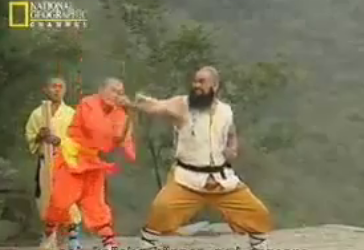
<div style="font-size: 0.8em; width: 364px;">Source: at approximately 1:28 minutes within <a href="http://www.youtube.com/watch?v=tX8mGt0K_JI">this video clip</a> on YouTube.</div>
</div>
<p>[hyphenate]Many of the seemingly impossible feats of highly skilled martial artists have little to do with hidden powers but are simple physics. For example, the ability to break a staff with one's arm is a question of tightening the muscle and positioning the arm at the precise spot on the staff where it is most likely to break, using one's arm as a pivot. It does not hurt, and it requires concentration more than anything else. I demonstrated it to my co-students last summer, and I am certainly no focused <a class="zem_slink" href="http://en.wikipedia.org/wiki/Qigong" title="Qigong" rel="wikipedia">Shaolin monk</a>.<br /><br />The stimuli may not be recognized consciously, but sometimes they or their combined effect are nonetheless felt as a derived stimulus as the body reacts to them:[/hyphenate] you do not consciously detect the stimuli themselves, but you do discover your reaction. This reaction may be violent, it may be a strong feeling that "something is wrong," or it may be a feeling that your weapon is magnetically drawn to a certain direction&#8212;but there is never a rational explanation why. The feeling is real, and it may be strong, too.<br /><br />I believe this is a rational approach to explaining what qi is. It is no force, and it does in fact not exist. However, the human consciousness is a rather limited faculty, and we physically sense much more than we become consciously aware of. Such stimuli are easily felt as some force emanating from others, and in a sense, it is fair to state that martial artists really do feel <i>something</i> from others and can bring the feeling to use, just like a martial artist may learn to cause certain reactions in other people; it is not qi, however, because it does not exist. To the best of my knowledge, it is the composite, secondary reaction to otherwise trivial stimuli.</p>
<div style="margin-top: 10px; height: 15px;" class="zemanta-pixie"><a class="zemanta-pixie-a" href="http://www.zemanta.com/" title="Enhanced by Zemanta"><img style="float: right;" class="zemanta-pixie-img" src="https://img.zemanta.com/zemified_e.png?x-id=042dbc4a-97bb-4c4f-b8d2-22ba704fe36f" alt="Enhanced by Zemanta" /></a></div>]]>
        
    </content>
</entry>

<entry>
    <title>My Un-Analytical Mind</title>
    <link rel="alternate" type="text/html" href="https://blog.blazingangles.net/wen/2011/11/my-un-analytical-mind.html" />
    <id>tag:blog.blazingangles.net,2011:/wen//8.2308</id>

    <published>2011-11-12T13:29:58Z</published>
    <updated>2015-11-25T13:18:36Z</updated>

    <summary>I&apos;m often described as an extremely analytical person. In my various jobs, managers who demanded linear, predictable, and otherwise uncreative progress have lamented what they considered my tendency to keep analyzing a subject before eventually producing a result. I excel...</summary>
    <author>
        <name>Ole Wolf</name>
        <uri>http://blog.blazingangles.net/soapbox/</uri>
    </author>
    
        <category term="Philosophy" scheme="http://www.sixapart.com/ns/types#category" />
    
    <category term="analysis" label="Analysis" scheme="http://www.sixapart.com/ns/types#tag" />
    <category term="science" label="Science" scheme="http://www.sixapart.com/ns/types#tag" />
    <category term="skill" label="Skill" scheme="http://www.sixapart.com/ns/types#tag" />
    <category term="thought" label="Thought" scheme="http://www.sixapart.com/ns/types#tag" />
    
    <content type="html" xml:lang="en-us" xml:base="https://blog.blazingangles.net/wen/">
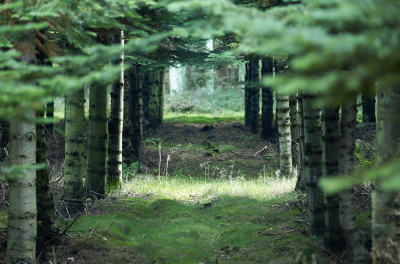
        <![CDATA[<p>I'm often described as an extremely analytical person. In my various jobs, managers who demanded linear, predictable, and otherwise uncreative progress have lamented what they considered my tendency to keep analyzing a subject before eventually producing a result. I excel in the technical and scientific areas. In the end, I produce work that seems immensely thought-through, rigidly analytical, carefully argued, and rigorously disciplined.<br /><br /><img alt="Forest Path" src="/wen/images/forest-path.jpg" class="mt-image-right" style="float: right; margin: 0 0 6px 20px;" height="264" width="400" />[hyphenate]But that is neither how I think, nor how I work. Presented with a problem, I see a landscape in front of me with lush valleys, impassable mountains and gorges, walls, streams, highways, buildings, paths, caves, dark forests, and hidden passages. The problem is an area in the distance that is sometimes clearly visible, at other times covered in a hazy mist that obscures the precise location, and sometimes it falls entirely beneath the horizon, giving itself away only by a magnetic attraction that guides the compass needle to point in its direction, or as distant rays revealing where the Sun is setting. It is a map for a Westward chase for the escaping light.[/hyphenate]<br /><br />I know the goal in advance: conclusions and results, and often side effects are known to me. Intermediate solutions are camp sites that may be planned; bad or imperfect solutions are directions leading away from the goal or which will cause detours. I see them immediately on the map when they are proposed. Only then begins analysis, which is packing for the trip and preparing for potential unknowns en route. It is usually completed in seconds or minutes, because the route is a glowing path through the landscape, and work may begin immediately.<br /><br />But unlike a journey where you move progressively, my mental landscape is superimposed onto reality. I travel, as it were, in an alternate set of dimensions, which I mean in a very allegorical sense; I do not make astral travels or otherwise have out-of-reality experiences. It is a "travel" that allows me to pave any one point of the path towards the goal at any time, to enable those who need the solution to somehow get there. The path is paved with whatever material I currently have available, and wherever it is in most need. I am unable to begin paving from the beginning, moving slowly to the end, because I lose sight of the end by focusing on the beginning.<br /><br />And so I cannot write a story beginning with chapter one. I write a passage here and a passage there. I leave large gaps of room in a document waiting to be filled, and I write statements that I cannot yet know in sections that depend on future events, trusting that they will make sense once their future becomes present. I am rarely forced to delete or redo any part; I only elaborate a little here, and a little there, adding details in the whole instead of detailing the already detailed. If I may for a moment abuse quantum physics beyond its province, I see the wave and alter its characteristics where everyone sees the particle and attempts to alter its course. The wave spans the landscape while the particle crosses it.<br /><br />My approach and others' approaches may yield identical results, but I am not the analyst. What may seem like careful and skilled analysis where effects lead to causes, which in turn lead to other effects and causes, is to me a mere description of what I see, with no intent to analyze or understand the path directly ahead. Perhaps that is the secret of the analytical gift.</p>]]>
        
    </content>
</entry>

<entry>
    <title>Ghost Story</title>
    <link rel="alternate" type="text/html" href="https://blog.blazingangles.net/wen/2011/09/ghost-story.html" />
    <id>tag:blog.blazingangles.net,2011:/wen//8.2296</id>

    <published>2011-09-16T15:26:19Z</published>
    <updated>2015-11-25T16:01:44Z</updated>

    <summary>A ghost is a deceased person that haunts the living, because the deceased person has unfinished business or lost property that was highly important to him. In spite of what healthy skepticism might prompt me to believe, I believe in...</summary>
    <author>
        <name>Ole Wolf</name>
        <uri>http://blog.blazingangles.net/soapbox/</uri>
    </author>
    
        <category term="Philosophy" scheme="http://www.sixapart.com/ns/types#category" />
    
    <category term="axismundi" label="Axis Mundi" scheme="http://www.sixapart.com/ns/types#tag" />
    <category term="death" label="Death" scheme="http://www.sixapart.com/ns/types#tag" />
    <category term="fetish" label="Fetish" scheme="http://www.sixapart.com/ns/types#tag" />
    <category term="ghost" label="Ghost" scheme="http://www.sixapart.com/ns/types#tag" />
    <category term="life" label="Life" scheme="http://www.sixapart.com/ns/types#tag" />
    <category term="myth" label="Myth" scheme="http://www.sixapart.com/ns/types#tag" />
    <category term="paranormal" label="Paranormal" scheme="http://www.sixapart.com/ns/types#tag" />
    
    <content type="html" xml:lang="en-us" xml:base="https://blog.blazingangles.net/wen/">
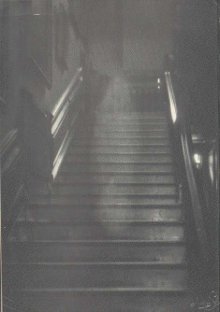
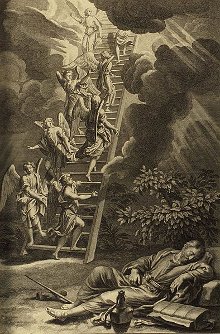
        <![CDATA[<p><img alt="Ghost" src="/wen/images/brown_lady_ghost.jpg" class="mt-image-right" style="float: right; margin: 0pt 0pt 8px 20px;" height="312" width="220" />A ghost is a deceased person that haunts the living, because the deceased person has unfinished business or lost property that was highly important to him. In spite of what healthy skepticism might prompt me to believe, I believe in ghosts, because I have seen many of them.<br /><br />As an atheist and a skeptic, however, I must insist that ghosts are tangible characters. So, when popular belief stipulates that ghosts are spirits, I must insist that this cannot be, and I also refuse to consider ghosts to be some kind of manifestation of a person's afterlife.<br /><br />A ghost is a dead person in the sense that the person has lost his life. A person that was once productive, alive, giving, and present but has since lost the spark of life and no longer has initiative is dead. Such invididuals may become ghosts.<br /><br />When a person &#8220;dies&#8221; and becomes a ghost, the death is often witnessed as a change in the person's life and friends wonder what happened to the once so pleasant person. The death occurs when a vital part of their life vanishes and takes the person's inner light with it, leaving a person who is eerily unreal and often unpleasant to meet.<br /><br />This may require some explanation.<br /><br />The person has been so closely attached to a &#8220;fetish&#8221;&#8212;a person, an idea, a cause, or an object&#8212;that it is inseparable from his life. Everything is understood and valued against the fetish that the person has attached himself to. Even if the individual might have had a realistic view on reality, his or her entire existence has been measured according to the fetish. A mother may thus enjoy life, but some mothers enjoy life <i>as mothers</i>, that is, not as independent individuals but through their relation to their child and the identity of being mothers. The child has become the mother's fetish.<br /><br />The fetish is the glass through which the person views his entire existence. It does not prevent the person from seeing clearly; in fact, it is vital for the person's clarify. The person's contact with reality goes through the person's fetish, and instead of using his own root as a guideline to his existence directly, the person applies his fetish as a an intermediary between his root and reality.<br /><br />This usually works well, but it is dangerous to be so dependent on an external factor. If you found out what a person's fetish is, you may control the person via his fetish, but that is another discussion. If you make a person hate his fetish, the person will hate himself, and his beacon will be his own self-hate. That, too, is another discussion.<br /><br />Back to the ghosts. Legends have established that ghosts are often looking for something that is lost, or the ghosts haunt people that own that which the ghosts have lost. If you destroy a person's fetish or make it inaccessible, you will remove the item that the person required to be in touch with himself, and hence the person's indicator of reality. The vital part of the person through which the person lived is gone. The person's spark of life disappears together with the disappearance of the fetish. The person &#8220;dies&#8221; but is unable to find rest without his fetish.<br /><br />That is the secret behind the curse of the ghosts. Ghosts of flesh and blood have lost their fetishes, and their curse can only be lifted if the ghosts can recover their lost fetishes or if they find a new fetish. In rare cases the ghosts may find their own root.<br /><br />The fetish is the person's <i><a class="zem_slink" href="http://en.wikipedia.org/wiki/Axis_mundi" title="Axis mundi" rel="wikipedia">axis mundi</a></i>, the indicator of world order. If the axis mundi is shifted even once, the world is destroyed. An Aboriginal tribe in Australia understood this concept so literally that they symbolized the axis mundi with a stick, and if the stick were to be destroyed, the tribe would sit down and wait to die, because the world order had been destroyed.<br /><br /><img alt="Jacob's Ladder" src="/wen/images/jacobs-ladder.jpg" class="mt-image-left" style="float: left; margin: 0pt 20px 8px 0pt;" height="334" width="220" />In the mythical universes the axis mundi connects the cosmic planes of existence. In Christianity, the axis mundi is symbolized by the Jacob's ladder, and in the Norse mythology it was Yddgrasil. The the individual, the axis mundi is the connection between sensing and interpretation of the senses, and the connection between his past and his future. It is the person's thread through life.<br /><br />The fetich is the person's single reference point that cannot afford to be shaken. If control of the fetish is lost even once, the basis of the person's world view is for ever uncertain. If the person's fetish is his girlfriend, she needs not demonstrate her disinterest more than once before the person's local world&#8212;himself&#8212;crumbles, even if the girlfriend finds her way back.<br /><br />Like their mythical counterpart, real ghosts haunt those living individuals that have life, warmth, and an inner flame. The haunted people are those who possess the fetishes of the ghosts.<br /><br />The ghosts make themselves present in different forms. You may forget about the ghost and only become aware of its existence when it rattles the chains of an inextinguishable bitterness. Or you may wonder why the ghosts return to people that they once had relations with, even if the ghosts themselves have long since renounced the relations. Or you may have been together with a ghost and leave with a feeling that the ghost was the only person in the party who gained from the contact. The presence of the ghosts is a transparent outline of that which the ghosts once felt they were as living individuals.<br /><br />The ghost may be the mother who has lost her child because the child has moved away from home or has freed itself from its parents, and who attempts to keep the child in its childish needs by helping with cooking or laundry. Or the ghost may be the old politician who has lost interest in politics but still turns to other politically active individuals about issues that he could easily discuss with anyone else.<br /><br />Ghosts may not walk through walls, but they are very real, and they cannot be slain like vampires with a proverbial stake through their hearts. Ghosts are also never kind. And unlike the ghosts of the myths and legends, ghosts may not be reunited with their lost identity by anyone; true ghost hunters need hard training in psychiatry. We other mortals can rarely dispell the ghosts. If we are unwilling to flee the haunted area, we must live with their howls at night and their chilly puffs down our backs.</p>
<div style="margin-top: 10px; height: 15px;" class="zemanta-pixie"><a class="zemanta-pixie-a" href="http://www.zemanta.com/" title="Enhanced by Zemanta"><img style="float: right;" class="zemanta-pixie-img" src="https://img.zemanta.com/zemified_e.png?x-id=e66e8bce-271b-41f1-b689-9a3d3f5baf09" alt="Enhanced by Zemanta" /></a></div>]]>
        
    </content>
</entry>

<entry>
    <title>The Art of Hunting Trolls</title>
    <link rel="alternate" type="text/html" href="https://blog.blazingangles.net/wen/2011/09/the-art-of-hunting-trolls.html" />
    <id>tag:blog.blazingangles.net,2011:/wen//8.2293</id>

    <published>2011-09-13T17:44:28Z</published>
    <updated>2015-11-25T13:20:11Z</updated>

    <summary>The forest of Rold in Denmark includes an area that is known as the troll forest owing to the eerie shape of the trees. There is a perfectly natural explanation for that, but that will have to wait, because this...</summary>
    <author>
        <name>Ole Wolf</name>
        <uri>http://blog.blazingangles.net/soapbox/</uri>
    </author>
    
        <category term="Creativity" scheme="http://www.sixapart.com/ns/types#category" />
    
    <category term="creativity" label="Creativity" scheme="http://www.sixapart.com/ns/types#tag" />
    <category term="forest" label="Forest" scheme="http://www.sixapart.com/ns/types#tag" />
    <category term="nature" label="Nature" scheme="http://www.sixapart.com/ns/types#tag" />
    <category term="troll" label="Troll" scheme="http://www.sixapart.com/ns/types#tag" />
    
    <content type="html" xml:lang="en-us" xml:base="https://blog.blazingangles.net/wen/">
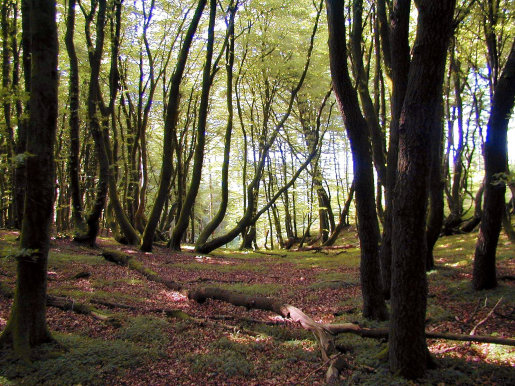
        <![CDATA[<p>The forest of Rold in Denmark includes an area that is known as the troll forest owing to the eerie shape of the trees. There is a perfectly natural explanation for that, but that will have to wait, because this is about the secret behind troll hunting.<br /><br />Troll hunting is difficult because you cannot enter the troll forest with the desire to hunt trolls. Everywhere you look you will see oddly shaped trees but trolls are nowhere to be seen.<br /><br /></p>
<div style="margin: 0px auto 6px; width: 515px;"><span class="mt-enclosure mt-enclosure-image" style="display: inline;"><img alt="Troll Forest in Rold Skov" src="/wen/images/troldeskoven.jpg" class="mt-image-center" style="text-align: center; display: block; margin: 0pt auto 6px;" height="386" width="515" /></span>
<div><span style="font-size: 0.8em;"><b>Troll Forest in the forest of Rold in Denmark. But where are the trolls?</b></span></div>
</div>
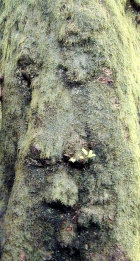
<p><br />The secret behind troll hunting is that the trolls will not appear until you cease looking for them. It is when you forget your business that the trolls begin to appear. Often a curious face will peek from behind the roots of a fallen tree, or a troll may be napping against a trunk. Soon you will see trolls everywhere in all shapes and sizes, and you feel them blowing down your neck and wink at you in time with the movement of the trees. But as soon as you begin looking for more trolls, you will not find any.<br /><br /></p>
<div style="margin: 0pt 0px 8px 20px; float: right; width: 140px;"><span class="mt-enclosure mt-enclosure-image" style="display: inline;"><img alt="trold-1.jpg" src="/wen/images/trold-1.jpg" class="mt-image-right" style="margin: 0pt 0pt 6px 0px;" height="261" width="140" /></span>
<div><span style="font-size: 0.8em;"><b>A somewhat camera shy troll, but visible nonetheless.</b></span></div>
</div>
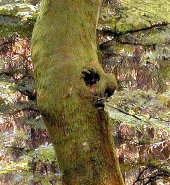
<div>The same thing happens if you attempt to find a good topic to write about. You cannot simply choose a topic and expect to find profundities. You must study the topic carefully, and suddenly meaning emerges. Of course, not all forests are troll forests, and some topics are more prone to insight than others.<br /><br />Trolls are shy and will hide when you approach them. There is often but a piece of wood or bark left when you walk towards them. But if you keep a proper distance, you will often be able to point them out for your companions who may not have seen them yet.<br /><br />Not all troll hunters are skilled. The trolls usually hide from troll huntes with too much sense in their heads who see nothing but trees. When they hunt for trolls, they search for the darkness with flashlights, trying to create trolls where there are none. When they are asked to describe the troll, they can rarely point at the nose, the eyes, and the mouth at the same time, seeing the entire face of the troll. They often describe a single closed eye that soon turns out not to belong to any troll. They also have difficiulties recognizing trolls that are found by more skilled hunters.<br /><br />
<div style="margin: 0pt 20px 8px 0px; float: left; width: 170px;"><span class="mt-enclosure mt-enclosure-image" style="display: inline;"><img alt="trold-2.jpg" src="/wen/images/trold-2.jpg" class="mt-image-left" style="margin: 0pt 0pt 6px 0px;" height="185" width="170" /></span>
<div><span style="font-size: 0.8em;"><b>Hush! This troll has not seen us yet.</b></span></div>
</div>
<div>Such people are rigid, and trolls are afraid of that. Trolls are part of the forest, and they quickly hide if they sense that a person lacks the life and movement of the forest. (This is also the reason why it is very difficult to take photographs of trolls, because the trolls know that the photographs will freeze them.) This is what makes troll hunting so difficult: you cannot become part of the troll forest until you forget that you are hunting trolls.<br /><br />The unfortunate troll hunters generally have difficulties understanding abstractions, analogies, symbols, and intuitive explanations, are are rarely creative.<br /><br />It is the unfortunate troll hunters who attempt to find profundities in their favorite topics or activities even if there is nothing to be found. Skilled troll hunters will find that certain topics provide a myriad of trolls.<br /><br />Some mystery cults would probably have sent the apprentice into Rold forest with no explanation but an instruction to come back once the apprentice had learned something. I will wish you happy hunting instead.<br />
<div></div>
</div>
</div>
<div style="margin-top: 10px; height: 15px;" class="zemanta-pixie"><a class="zemanta-pixie-a" href="http://www.zemanta.com/" title="Enhanced by Zemanta"><img style="float: right;" class="zemanta-pixie-img" src="https://img.zemanta.com/zemified_e.png?x-id=47bcd01f-5305-4837-956b-cf58f810641c" alt="Enhanced by Zemanta" /></a></div>]]>
        
    </content>
</entry>

<entry>
    <title>The Destruction of Truth</title>
    <link rel="alternate" type="text/html" href="https://blog.blazingangles.net/wen/2011/09/the-destruction-of-truth.html" />
    <id>tag:blog.blazingangles.net,2011:/wen//8.2292</id>

    <published>2011-09-13T16:46:07Z</published>
    <updated>2015-11-25T16:02:14Z</updated>

    <summary>[hyphenate]Truth is reserved for misguided humans who believe that truth is a goal.Truth is sought by humans who are culturally trained to believe that somewhere, someone knows what is &#8220;true.&#8221; They believe it is the duty of each human being...</summary>
    <author>
        <name>Ole Wolf</name>
        <uri>http://blog.blazingangles.net/soapbox/</uri>
    </author>
    
        <category term="Philosophy" scheme="http://www.sixapart.com/ns/types#category" />
    
        <category term="Religion" scheme="http://www.sixapart.com/ns/types#category" />
    
    <category term="devil" label="Devil" scheme="http://www.sixapart.com/ns/types#tag" />
    <category term="goal" label="Goal" scheme="http://www.sixapart.com/ns/types#tag" />
    <category term="god" label="God" scheme="http://www.sixapart.com/ns/types#tag" />
    <category term="knowledge" label="Knowledge" scheme="http://www.sixapart.com/ns/types#tag" />
    <category term="satan" label="Satan" scheme="http://www.sixapart.com/ns/types#tag" />
    <category term="science" label="Science" scheme="http://www.sixapart.com/ns/types#tag" />
    <category term="truth" label="Truth" scheme="http://www.sixapart.com/ns/types#tag" />
    
    <content type="html" xml:lang="en-us" xml:base="https://blog.blazingangles.net/wen/">
        <![CDATA[<p><img alt="Eliphas Levi's Goat of Mendes" src="/wen/images/eliphas-levi-goat.png" class="mt-image-right" style="float: right; margin: 0pt 0pt 20px 20px;" height="390" width="300" />[hyphenate]Truth is reserved for misguided humans who believe that truth is a goal.<br /><br />Truth is sought by humans who are culturally trained to believe that somewhere, someone knows what is &#8220;true.&#8221; They believe it is the duty of each human being to either be this person or to work hard to comprehend through this person what is &#8220;true.&#8221; Even if they may not formally or literally believe in gods, it is implied by their culture that it is &#8220;God&#8221; who holds the final and eternal truth.<br /><br />The Devil has no interest in aspiring for his opponent. Satan turns his back at God. He knows that there is no such thing as &#8220;true.&#8221; Satan does not want truth. Satan is the perpetual liar, and it is his corruptive nature to destroy truth.<br /><br />Yet a truth that has been forced to adapt to the Devil's eternal question mark and destruction through the ages has not become a lie; it has only been progressively less wrong. Satan's obstinate desire to destroy truth as we know it has replaced the term &#8220;true&#8221; with the term &#8220;progessively less wrong.&#8221;[/hyphenate]<br /><br />It may sound as if Satan inadvertently attains the very goal that he wishes to avoid, but there is a monumental difference between the two concepts.<br /><br />&#8220;True&#8221; is something that is measured as the distance from an absolute, constant merit, which is an ultimate goal. The closer something is to this goal, the more true it is.<br /><br />&#8220;Progessively less wrong&#8221; is measured according to a point of departure. It is a measure of how far you have reached and how far you have progressed.<br /><br />&#8220;True&#8221; is an angst of not being close enough to God&#8212;a fear that cannot be eased, because there are no gods. The wish to reach the goal is a death wish, because once the wish has been granted, there is nothing more to strive for.<br /><br />To be &#8220;progressively less wrong&#8221; is to revel in your own progess, and it is a perennial desire to always go further.<br /> <br />The desire for &#8220;truth&#8221; creates rigid societies. People think in terms of &#8220;right&#8221; when they maintain their own, &#8220;true&#8221; course while they actively combat any other course and are hostile towards discussion and perspective.<br /><br />The desire to be &#8220;progressively less wrong&#8221; leads society in new directions. It encourages respect for past knowledge and enthusiasm for constributing with new knowledge, to lifelong learning, and to an appreciation of the fact that there is great value to be found in the interaction between humans with unique views.<br /><br />But it is not easy to be &#8220;progressively less wrong&#8221; instead of being &#8220;more right.&#8221; Many people have a feeling of what is &#8220;right&#8221; and do not have the slightest idea of how to be &#8220;less wrong.&#8221; They belive you are opting for the second-best solution when you wish to be &#8220;less wrong&#8221; rather than &#8220;more right.&#8221; This, in spite of life itself being a monument to the fact that there is nothing second-best to beling &#8220;progressively less wrong.&#8221;<br /><br />To learn what is wrong in a popular &#8220;truth,&#8221; we must follow the Devil's example.<br /><br />Satan does not belive in false authorities who know in advance what is &#8220;right.&#8221; Satan has much more respect for those people who seek to demolish truths&#8212;assuming these people are not merely motivated by another &#8220;truth.&#8221; Satan believes in chaos, because he trusts people to be creative, and he trusts that a large number of people that do not share an opinion are capable of functioning together.<br /><br />To be &#8220;progessively less wrong&#8221; demands the Devil's tools: the ability to be critical and to learn from your own and others experiments, but also to keep an open mind that allows controversional thoughts and acts. The key talent is creativity, but unfortunately our god-fearing culture is suspicious of this chaotic skill, or may have lost its belief in it or forgotten it in its quest for maximum profit or &#8220;financial responsibility.&#8221;<br /><br />A truth that cannot be destroyed is promoted to divinity and will enthrall independent thought. In his destruction of truth, Satan therefore demands bickering and dispute, obstacles and destruction, frustration and error. Only thus can truth be destroyed and mankind be liberated from God.</p>
<div style="margin-top: 10px; height: 15px;" class="zemanta-pixie"><a class="zemanta-pixie-a" href="http://www.zemanta.com/" title="Enhanced by Zemanta"><img style="float: right;" class="zemanta-pixie-img" src="https://img.zemanta.com/zemified_e.png?x-id=b13fcfbc-e930-4a0a-8f8d-bfe148ab6ee7" alt="Enhanced by Zemanta" /></a></div>]]>
        
    </content>
</entry>

<entry>
    <title>The Mythical Nazi</title>
    <link rel="alternate" type="text/html" href="https://blog.blazingangles.net/wen/2011/09/the-mythical-nazi.html" />
    <id>tag:blog.blazingangles.net,2011:/wen//8.2286</id>

    <published>2011-09-05T15:49:59Z</published>
    <updated>2015-11-25T13:21:11Z</updated>

    <summary>[hyphenate]It is usually considered bad practice to compare groups that you don&apos;t like with Nazis. This comparison is made so often, however, that it has earned its own name: Godwin&apos;s Law. The &quot;law&quot; states that most discussions on the Internet...</summary>
    <author>
        <name>Ole Wolf</name>
        <uri>http://blog.blazingangles.net/soapbox/</uri>
    </author>
    
        <category term="Politics" scheme="http://www.sixapart.com/ns/types#category" />
    
    <category term="adolfhitler" label="Adolf Hitler" scheme="http://www.sixapart.com/ns/types#tag" />
    <category term="godwinslaw" label="Godwin&apos;s Law" scheme="http://www.sixapart.com/ns/types#tag" />
    <category term="nazi" label="Nazi" scheme="http://www.sixapart.com/ns/types#tag" />
    <category term="worldwarii" label="World War II" scheme="http://www.sixapart.com/ns/types#tag" />
    
    <content type="html" xml:lang="en-us" xml:base="https://blog.blazingangles.net/wen/">
        <![CDATA[<p><img alt="Swastika" src="/wen/images/swastika.png" class="mt-image-right" style="float: right; margin: 0pt 0pt 20px 20px;" height="240" width="300" />[hyphenate]It is usually considered bad practice to compare groups that you don't like with Nazis. This comparison is made so often, however, that it has earned its own name: <a href="http://en.wikipedia.org/wiki/Godwin%27s_law">Godwin's Law</a>. The "law" states that most discussions on the Internet newsgroups invariably end with one part accusing the other part of being a Nazi, and that this accusation marks the end of any constructive debate. The reason is that discussions often become more heated and invectives become more fierce, and because "Nazi" is considered the worst you can say, this invective indicates that the debate has removed the parties as far as possible. The rule is virtually universal, but there is an obvious situation where it does not apply: if your opponent is a genuine nazi, it is absolutely fair to refer to the opponent as a Nazi! This is noted in the <a href="http://www.faqs.org/faqs/usenet/legends/godwin/">Godwin's Law FAQ</a>, which dryly observes that this law is not useful by neither part. It suggests one talks <i>about</i> Nazis instead of talking <i>with</i> Nazis.[/hyphenate]<br /><br />There is a gray area, however, where the person you debate with is a Nazi in every respect, except that the person himself or herself either won't admit or doesn't believe he or she is a Nazi. If you refer to the person as a Nazi, you'll be correct, but the person will be insulted either for political reasons or as a result of ignorance.<br /><br />There is a certain fairness in accepting that if someone rejects a particular name, one should at least consider honoring the rejection. It should not be honored uncritically, however; if a <a class="zem_slink" href="http://en.wikipedia.org/wiki/Holocaust_denial" title="Holocaust denial" rel="wikipedia">Holocaust denier</a> argues in favor of Nazism cannot be called a Nazi simply because he or she claims (or believes) to be otherwise, the person's rejection cannot have much weight. Compare it with the situation with athletes from Eastern Europe or China some decades ago, who officially were "unprofessional" athletes but whom anyone knew were 100% dedicated to their sport by their respective countries, and only were allowed in the Olympic games because their countries emphasized that they were not paid. In any sense but the strictest level of formality, obviously these athletes were professional; anything else is a matter of words. (This recurring conflict solved itself as commercial interests in other countries began to sponsor the athletes who could also no longer unambiguiously be considered amateurs.)<br /><br />There is thus a <i>lower limit</i> for <i>not belonging</i> to a particular group: you may be so similar that it does not make sense to consider you different. You are not necessarily the person you think you are, or what you attempt to convince others that you are.<br /><br /><img alt="SS Badge" src="/wen/images/ss-badge.jpg" class="mt-image-left" style="float: left; margin: 0pt 20px 20px 0pt;" height="350" width="350" />[hyphenate]Some of my close relatives were members of the Nazi party during the <a class="zem_slink" href="http://en.wikipedia.org/wiki/World_War_II" title="World War II" rel="wikipedia">Second World War</a>; one was an SS officer and the other was honored with a seat next to the <a class="zem_slink" href="http://en.wikipedia.org/wiki/F%C3%BChrer" title="Führer" rel="wikipedia">Führer</a> at one of his birthday parties. If anyone were Nazis in Germany in the 1930'es and 1940'es, it would these two people. I knew them both as very pleasant human beings who would always contribute positively to any occasion, and who did so out of genuine interest, not as an attempt to make up for their pasts.<br /><br />Many Nazis at that time must have held much more moderate beliefs than these two people, and some presumably smaller number must have been less moderate. This indicates that here, too, there has to be a lower limit of how excluding the definition of Nazism can be, because if there were not many "degrees" of being a Nazi, how many people would qualify? If you narrow Nazism to a phenomenon that could only describe a tiny number of exceptionally cruel individuals, then how could there be so many millions of Nazis in Germany before and after the Second World War?[/hyphenate] Were these millions of Nazis in the period between 1920 and 1945 really so similar that there were no small or even considerable differences? Did they all disappear, and with them also nazism, as through magic when Germany lost the war? If the definition of Nazism is so narrow that it does not fit anyone, were there even Nazis in Germany before and during the Second World War?<br /><br />The answers are as obvious as they may be discomforting: firstly, Nazism covered a wide array of people because otherwise there could never have been that many Nazis. Secondly, Nazis did not radically change their opinions on the night between August 2nd and August 3rd, 1945 after the <a class="zem_slink" href="http://en.wikipedia.org/wiki/Potsdam_Conference" title="Potsdam Conference" rel="wikipedia">Potsdam conference</a>; they just knew to keep their mouths shut. In short, Nazis were humans, and humans are different. Nazism was found in many shades and different Nazis had different emphasis on its ideological core principles. There is not a single, precise weighting but rather an inclusive sphere spanneing various weightings of core ideologies, and they did not simply vanish from the many options provided by human consciousness. It is this fact that make the answer discomforting: if Nazism fills a spacious sphere of different opinions and does not unequivocally demand that one behaves like a Hollywood Nazi archetype, then it means that we are surrounded by people who would have been clearly recognizable as Nazis by the standards of Germany, 1930.<br /><br />More specifically: a number of core principles outlined a circle around the many different Nazis of the 1920'es and 1930'es. If a group of people today believes in core principles that by and large are contained within this circle, then this group would have been part of contemporary Nazism had the group existed back then.<br /><br />The strong condemnation of the horrors of World War II has created a fear of contact with Nazism, which has a very unfortunate side effect: the post-war descriptions of the horrors during the Second World War has created an anthropomorphism, that is, they have transformed Nazis into a symbol of the horrors. The post-war condemnations have created the <i>mythical Nazi</i>&#8212;the spectre of the worst thinkable human being, all of the Nazi horrors integrated into a single person.<br /><br />The mythical Nazi is mythical, because the mythical person does not exist. The Nazis of the real world were not like the mythical Nazi. The mythical Nazi and the real Nazi appear in different realities. The mythical Nazi is found in the world where you find dragons, trolls, and other monsters. The real Nazi is found in our own world. These Nazis had many opinions and values, dreams and ideas, hopes and plans, and they were human beings of flesh and blood like the rest of us.<br /><br />When you speak of the real Nazis, you must not confuse them with the mythological Nazi. The two phenomena are completely different, and any commingling of them will turn the discussion meaningless. Think of the word "bat," which takes on completely different meanings depending on whether you are talking about animas or sports. If you assume one meaning in another context, you will not be making any sense.<br /><br />The notion of the mythical Nazi is unfortunate because it makes it difficult (if not impossible) to recognize real Nazis. You will never spot a real Nazi if you believe that a real Nazi can only be recognized by the traits of the mythical Nazi, because you will be gazing into a fantacy world that is not populated by real, existing people. It may be compared to question that my four year old son asked one night when he gazed into the night sky: he asked what all the glowing dots were and why there were no stars. It turned out that he had learned through images and stories that stars are five-pointed and big, and therefore did not recognize the real stars. Like my little son did not recognize the real stars, you will not recognize the real Nazis around you if you think they must all be like the mythical Nazi.<br /><br />People who would be recognized as Nazis with no shread of doubt in the 1930'es, and who might even have known so themselves, can now get away with Nazi positions without anyone&#8212;or even themselves&#8212;realizing it. If someone points out that there is remarkable agreement between the opinions, either Godwin's law applies, or popular belief in the mythical Nazi is so strong that others cannot relate the concept of a Nazi to anything real and present. The post-war chase after Nazis was justified by portraying the nazis as so evil that they could be outlawed. But this justification created a Nazi monster that was so terrifying that no one can recognize its much more commonplace face.<br /><br /><img alt="Nazi Armband" src="/wen/images/nazi-armband.jpg" class="mt-image-right" style="float: right; margin: 0pt 0pt 20px 20px;" height="195" width="300" />[hyphenate]Nazis of today are unlike the mythical Nazi, because the mythical Nazi never existed. Nazis of today are not necessarily goose-stepping down the Straße, do not necessarily wear armbands, and do not necessarily call themselves Nazis. Only the mythical Nazi does all of this, as well as the few individuals who attempt an ostensive act of the universe of the mythical symbol.<br /><br />Germany had millions of Nazis back then. How many of these Nazis were shouting "Heil!" in the streets back then? How many of those who even knew about the persecution of the Jews played any active role in it? How many of them wore a Swastika as jewelry?[/hyphenate] How many of them believed that their own children should be killed if they had physical disabilities? How many of them were interested in Hitler's religious mysticism? When not even the majority of the Nazis <i>back then</i> were anything like the mytical Nazi, why demand that Nazis of today should look like this mythical being before they can reasonably be called Nazis? Or rather: why not call them Nazis if they otherwise are like the Nazis of the past, just because a mythical creature has been invented that does not exist?<br /><br />Belief in the mythical Nazi must be cast away to all other superstition of witches, trolls, ghosts, and dragons. We must realize that the Nazi of today is like the Nazis of the past with mostly the same opinions, values, ideas, and desires. And we must remember what these opinions were, and that they can only be implemented by repeating the horrors of World War II. We do not exorcise Nazism by denying to read Adolf Hitler's <a href="http://en.wikipedia.org/wiki/Mein_Kampf"><i>Mein Kampf</i></a>, believing it may turn us into the mythical Nazi; instead, reading the book, whose language is no harsher than that of an average politician, might open your eyes to very real Nazis around you. We must recognize Nazism today by any name if we wish to ensure that History does not repeat itself.<br /><br /></p>

<div style="margin-top: 10px; height: 15px;" class="zemanta-pixie"><a class="zemanta-pixie-a" href="http://www.zemanta.com/" title="Enhanced by Zemanta"><img style="border: none; float: right;" class="zemanta-pixie-img" src="https://img.zemanta.com/zemified_e.png?x-id=c64ca234-9d66-4818-8b3f-791f92da9345" alt="Enhanced by Zemanta" /></a></div>]]>
        
    </content>
</entry>

<entry>
    <title>Politically Institutionalized Breivik</title>
    <link rel="alternate" type="text/html" href="https://blog.blazingangles.net/wen/2011/09/politically-institutionalized-breivik.html" />
    <id>tag:blog.blazingangles.net,2011:/wen//8.2285</id>

    <published>2011-09-04T09:16:34Z</published>
    <updated>2015-11-25T13:26:37Z</updated>

    <summary>Commercials work. Political campaigns shift votes. Children become educated in schools. Negotiations foster results. By and large, humans influence each others through speaking with each other. Everything we say is intended to move one or more opponents. It would make...</summary>
    <author>
        <name>Ole Wolf</name>
        <uri>http://blog.blazingangles.net/soapbox/</uri>
    </author>
    
        <category term="Politics" scheme="http://www.sixapart.com/ns/types#category" />
    
    <category term="andersbreivik" label="Anders Breivik" scheme="http://www.sixapart.com/ns/types#tag" />
    <category term="extremism" label="Extremism" scheme="http://www.sixapart.com/ns/types#tag" />
    <category term="personalitydisorder" label="Personality Disorder" scheme="http://www.sixapart.com/ns/types#tag" />
    <category term="politics" label="Politics" scheme="http://www.sixapart.com/ns/types#tag" />
    <category term="scandinavia" label="Scandinavia" scheme="http://www.sixapart.com/ns/types#tag" />
    
    <content type="html" xml:lang="en-us" xml:base="https://blog.blazingangles.net/wen/">
        <![CDATA[<p>Commercials work. Political campaigns shift votes. Children become educated in schools. Negotiations foster results. By and large, humans influence each others through speaking with each other. Everything we say is intended to move one or more opponents. It would make no sense to debate if we did not influence each other with our words. All communication would be meaningless. The sounds generated in our larynxes would fall on deaf ears, and as a species we would probably never have developed a language. There is no Cartesian dualism where voice and spirit is separated from body and action.<br /><br /> Tell a person that has been a bully victim that repetitive hostile rhetoric or persistent belittlement that words cannot hurt. They may break a child as efficiently and as permanently as violence and sexual abuse. Tell a person who struggles to balance his or her financial situation that the words "you're fired" have no physical consequences before the layoff is effectuated. Tell an innocent person who receives a death sencence in an American court as a result of the prosecutor's sharp tongue that words pose no danger. Tell the person that attempts suicide after years of directed character assinations that noone attempted to cause real damage. Tell the hundreds of thousands of refugees from Iraq that the lies about weapons of mass destructions meant nothing.<br /><br /> If a politcal party did not expect their words to convey any meaning and caused the population to change their behavior, the party would withdraw from the public and stop wasting its time on TV commercials, in debates, in radio interviews, in newspaper columns, and in campaign adverts. No voter would be influenced by the communication, but would vote entirely independent of the messages from the political parties. It is simply obvious that communication from political parties aim to move the population in one way or another. The choice of rhetoric, the choice of subjects, and the choice of argumentation all aim to change the behavior of the population. It is neither unwanted or undesired if an individual is unaffected by the communication from the political parties, it is an <i>unthinkable</i> thought.<br /><br /> Long time of persistent messages create communicating communities of agreement - discourses - which are even ranked alongside the definition of reality, because reality is not objective but a social definition - through language. Language describes reality: the words attached to meanings that are worth assimilating or opposing, sentences defines the subjects that one is expected to be concerned with; the language composes the reality that is describable and thus relatable. The more a reality is described in one's society, the more present it becomes; it becomes institutionalized.<br /><br /> <img alt="Anders Breivik" src="/wen/images/anders-breivik.jpg" class="curvaceous mt-image-right" style="float: right; margin: 0 0 10px 40px;" height="287" width="218" />[hyphenate]And that is why the racist discourse of the Scandinavian right-wing parties plays a role in creating animosity against immigrants in the Scandinavian populations. The strong and persistent anti-Muslim discourse creates hostility against Middle-Eastern populations in the societies. It would be crazy to suggest that this hostility had grown entirely independently of the right-wing parties, even if taking into account that the parties themselves are influenced by their respective support bases. Deny this nexus, and you must deny one of the most important pillars of language, philosophy, and dissemination of knowledge. <br /><br /> This make the Scandinavian right-wing parties squarely co-responsible for the position that the right-extremist, Norwegian mass murderer Anders Breivik had articulated; even Breivik himself knew this and referred to the Norwegian and Danish right-wing parties. Anders Breivik can be expected to suffer from a personality disorder, but it the rhetoric question is obvious: would Anders Breivik's personality disorder have become manifest as mass murder if his perception of reality had been nourished by a rhetoric about peaceful coexistence instead of the hostile rhetoric applied by his political idols?[/hyphenate]<br /><br /> The answer, as Philip Zombardo has stressed, to examine the individual only when all other explanations have been abandoned; you are not who you are; you are <i>where</i> you are, that is, your identity and demeanor is primarily determined by your physical and communicative surroundings. Anders Breivik had taken note of the rhetoric and embodied it. Much of the hostile rhetoric would only be possible through actions such as Anders Breivik's on a larger scale. Imprisonments in concentration camps, genocide, and mass deportations are the only way the hostile rhetoric could be accomplished in practice, and in this light, Anders Brevik's only personality disorder is his lacking ability to understand that the action, and hence the rhetoric, is insane.<br /><br /> It is not even certain that Anders Brevik suffers from a personality disorder. If a hundred people stand at the docks and yell: "push him off the docs!" about a person and one of the 100 people suddenly pushes the person, it would be absurd to assign all blame to that one person and claim that the shouts of the remaining 99 individuals had never been heard. Anders Breivik's statements and opinions are far from unheard on the extreme right wing, and he may have been led by the extremist rhetoric in the same way as solders are driven to shoot at an enemy that they have been conditioned to view as inhuman.<br /><br /> The Scandinavian right-wing parties cannot be held responsible for the probability that Anders Breivik suffers from a personality distorder, but their rhetoric guides the actions and opinions that a person such as Anders Breivik will assume. It is shameful that instead they cast all guilt aside and continue with their hateful rhetoric as usual.</p>]]>
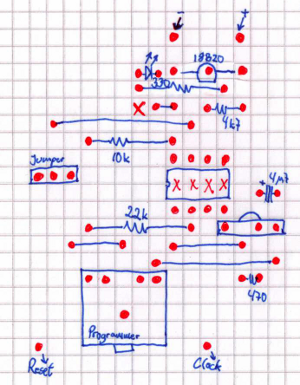
        
    </content>
</entry>

<entry>
    <title>The Stabwounds in My Back</title>
    <link rel="alternate" type="text/html" href="https://blog.blazingangles.net/wen/2011/09/the-stabwounds-in-my-back.html" />
    <id>tag:blog.blazingangles.net,2011:/wen//8.2283</id>

    <published>2011-09-01T21:01:27Z</published>
    <updated>2011-09-04T12:06:23Z</updated>

    <summary>Popular belief states that &quot;everybody loves a winner.&quot; However, popular opinion reflects human opinion and rarely observable and quantifiable reality, and generally couldn&apos;t be much further from the truth: Nobody likes a winner, and everybody loves to hear about a...</summary>
    <author>
        <name>Ole Wolf</name>
        <uri>http://blog.blazingangles.net/soapbox/</uri>
    </author>
    
        <category term="Realism" scheme="http://www.sixapart.com/ns/types#category" />
    
    <category term="jobsecurity" label="Job Security" scheme="http://www.sixapart.com/ns/types#tag" />
    <category term="projectmanager" label="Project Manager" scheme="http://www.sixapart.com/ns/types#tag" />
    <category term="skills" label="Skills" scheme="http://www.sixapart.com/ns/types#tag" />
    
    <content type="html" xml:lang="en-us" xml:base="https://blog.blazingangles.net/wen/">
        <![CDATA[Popular belief states that "everybody loves a winner." However, popular opinion reflects human opinion and rarely  observable and quantifiable reality, and generally couldn't be much further from the truth: Nobody likes a winner, and everybody loves to hear about a winner being torn down or a winner failing. If
 in doubt, consult the tabloids which bulge with scandals, 
accidents, and disasters.<br /><br />That's why the so-called geek is bullied in school; it is why the eggheads are ridiculed; it is why the worst thing you can tell a religious nut out to save you is that you
 are already been saved, because the person doesn't want you to be 
saved; and it is the reason why expert opinions are consistently throttled and replaced by complacent yay-sayers by right-wing governments who need to "get something done."<br />
<br />It is the reason why you should never strive to become the best in your professional life. Strive to become second-worst according to the following two rules:<br /><br />Rule 1: You must be better than the worst performer, because is the one that gets the ax during corporate "rightsizings," and you must be just superior enough to avoid the pink slip.<br /><br />Rule 2: The best performer is the primary challenge to anyone who is threatened by the perpetually looming layoff rounds, which means that the best performer is always a challenge to everyone else. It is the best performer that gets knifed in the back, never the worst performer, because only the better performers pose a threat to your job security.<br /><br />Your challenge is to strike a balance where you avoid as many knives in your back as possible while being barely skilled enough to make it through the next stable period.<br /><br />Contrary to what you might think, your project manager will not appreciate your skills. Your project manager is paid to do his or her job, and the faster his or her team completes the project, the sooner the project manager is in need of a new assignment which may not be available. The project manager's job security increases with the slowness of the project team, and not only do the best performers expose the project manager's occasional ignorance, they also endager the project manager's job security by completing the project faster. If the project manager's boss begins to wonder, the worst performers in the team can always be sacrificed, because it is never the project manager's fault that the team is slow.<br /><br />Hence, any skilled project manager who is determined to keep his or her job will slander the best performer and lie about the person if it helps. The project manager will usually choose to tell your boss that you are considering a new job or that you are helping some other department, because this is a codified message known only to senior management that a person is unwanted: it instructs senior management that a person is a threat to them, too.<br /><br />And so skill is undesired. One would think that, in spite of our major scientific headway and occasional wonders of civilization, mankind would have progressed to a state where life could be a wonder to be lived rather than the battle to be fought that still charaterizes the life of less advanced species, but no; humans have not truly advanced to a state that is any different from the beasts of the wild. Mentally, we are still primitive apes struggling to survive being yet another experiment of evolution which, statistically speaking, is guaranteed to fail. Were it not for business competitiveness, we might have succeeded.<br /><br /> ]]>
        
    </content>
</entry>

<entry>
    <title>Beer Brewing Thermometer</title>
    <link rel="alternate" type="text/html" href="https://blog.blazingangles.net/wen/2011/06/beer-brewing-thermometer.html" />
    <id>tag:blog.blazingangles.net,2011:/wen//8.2263</id>

    <published>2011-06-17T11:52:47Z</published>
    <updated>2015-11-25T15:52:58Z</updated>

    <summary>A friend of mine is an avid all-grain home beer brewer. He prefers to keep things as manual as possible, but one thing bugs him: the thermometer is a delicate piece of equipment, and the mashing process requires careful monitoring...</summary>
    <author>
        <name>Ole Wolf</name>
        <uri>http://blog.blazingangles.net/soapbox/</uri>
    </author>
    
        <category term="DIY" scheme="http://www.sixapart.com/ns/types#category" />
    
    <category term="beer" label="Beer" scheme="http://www.sixapart.com/ns/types#tag" />
    <category term="doityourself" label="Do It Yourself" scheme="http://www.sixapart.com/ns/types#tag" />
    <category term="electronics" label="Electronics" scheme="http://www.sixapart.com/ns/types#tag" />
    <category term="picaxe" label="PICAXE" scheme="http://www.sixapart.com/ns/types#tag" />
    
    <content type="html" xml:lang="en-us" xml:base="https://blog.blazingangles.net/wen/">
        <![CDATA[<p>A friend of mine is an avid all-grain home beer brewer. He prefers to keep things as manual as possible, but one thing bugs him: the thermometer is a delicate piece of equipment, and the mashing process requires careful monitoring of the temperature. Of course, digital thermometers come a dime a dozen, but how about a thermometer that can be programmed for a target temperature and tells him to increase or decrease the heat? It's a thermostat, yes, but for a DYI guy like him, a home-made one is better than anything you can find at a store.<br /><br /><img alt="Beer Thermostat, Veroboard" src="/wen/images/beer-thermostat.png" class="mt-image-right" style="float: right; margin: 0pt 0pt 8px 20px;" height="385" width="300" />[hyphenate]This is a job for the PICaxe 08M, which has built-in support for the Dallas Semiconductors DS18B20 1-wire temperature probe.<br /><br />The first version is quite simple: the user sets the target temperature using an IR remote, and the 08M writes back the entry on a two-digit display. Next, the 08M continuously measures the temperature via the DS18B20, and lights an LED if the heater must be turned up. The user may change the target temperature any time using the remote. The IR device is a TSOP 1138.<br /><br />The hardware is about as simple as it can be. Note that the veroboard strips must be broken in five places. A jumper is used to determine whether input pin 0 should be used for programming (jumper position closest to the processor), or for resetting the display (covered shortly) once the circuit is running.<br /><br />Future revisions may involve the use of a servo motor for turning up or down the heater with only very minor modifications of the hardware and software.[/hyphenate]<br /><br />The display makes use of two 4026 decade counters with built-in 7-segment drivers. Only two wires are required to display two digits: one reset signal that resets the decade counters to 00. The other is a clock that is pulsed to count to the desired output. The counting is fast enough to cause only a small fluttering of the display as the desired output is reached:<br /><br /><img alt="Flash Trigger Veroboard" src="/wen/images/flash-trigger-board-display.jpg" class="mt-image-center" style="text-align: center; display: block; margin: 0pt auto 0px;" height="281" width="520" /><br />The 08M is stalled while executing the <i>infrain2</i> instruction. In order to allow continuous temperature measurement, instead the 08M polls for activity on the IR pin. If any activity is detected, it enters an input mode. Similarly, the 08M is stalled while reading the DS18B20. Hence, rather than measuring repeatedly, in order to accept IR input the 08M must be explicitly told to do nothing for a while (i.e., doing nothing but polling for IUR input) so that the risk of entering an input just when the 08M reads the DS18B20 is kept at a tolerable level. The program works its way somewhat around the stalls by reading the DS18B20 only about every 15 seconds.<br /><br />The DS18B20 is mounted in a copper pipe with brass ends, allowing it to be submerged in the warm or boiling wort during the entire brewing process:<br /><br /><img alt="Beer Thermostat, Disassembled" src="/wen/images/beer-thermostat-disassembled.jpg" class="mt-image-center" style="text-align: center; display: block; margin: 0pt auto 0px;" height="137" width="520" /><br />The 08M is programmed with the following program by placing the jumper closest to the processor:<br /><br /></p>
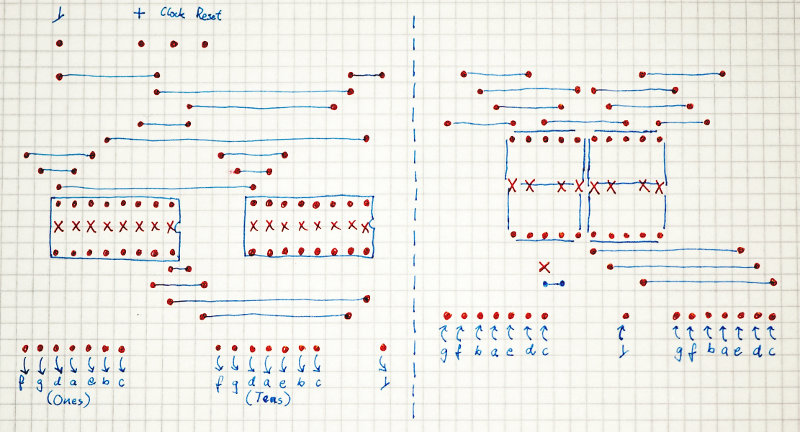
<pre style="font-size: 0.8em;">' Beer Brew Temperature Control

' Usage:
' NN: Set the target temperature, which is displayed for<br />' one second. Then the display shows the current<br />' temperature.

#picaxe 08m
#com /dev/ttyUSB0

' Preload the EEPROM with defaults:
' Value: Last target temperature.
eeprom 0, ( 60 )


' Pin 0: Reset 4026-based 7-segment counter.
' Pin 1: Input from sensor.
' Pin 2: Output to heater indicator.
' Pin 3: IR input.
' Pin 4: Count a 4026-based 7-segment counter.
input 1
output 0, 2, 4

symbol i = b0
symbol two_digits = b1
symbol targettemperature = b2
symbol currenttemperature = b3
symbol lasttemperature = b4
symbol difference = b5
symbol waitcounter = w3 ' b6:b7
symbol irreceiverpin = pin3
' symbol infra = b13 (these are synonymous)

' Turn off heater.
low 2

' Restore the settings from EEPROM.
read 0, targettemperature
lasttemperature = -127

main:
	waitcounter = 15000
	' Wait for a key. Poll for a key in order to let the temperature be<br />	' updated repeatedly.<br />poll:
	if irreceiverpin = 0 then
		infrain2

		' If it's a digit key, then it's the target temperature.
		if infra &lt; 10 then
			' Decode the first key, bypassing wait and validation.
			gosub getonedigit_nowait
			' Get the second digit of the two-digit number.
			gosub getseconddigit
			targettemperature = two_digits
			' Store the target temperature in EEPROM.
			write 0, targettemperature

			' Show the target temperature for two seconds before<br />			' showing the current temperature.
			pause 1000
			lasttemperature = -127
			goto sampletemperature
		endif
	endif

	' Count down until about half a minute before sampling the temperature.
	waitcounter = waitcounter - 1
	if waitcounter &gt; 0 then poll


	' Read the temperature. We won't compensate for impossible<br />	' negative temperatures.
sampletemperature:
	readtemp 1, currenttemperature
	' Show the current temperature again if it has changed.
	if currenttemperature &lt;&gt; lasttemperature then
		lasttemperature = currenttemperature
		two_digits = currenttemperature
		gosub showtwodigits
	endif

	gosub adjustheater

	goto main


' Turn heater on or off, depending on temperature. This could be<br />' modified to, e.g., set a servo motor to open or close a valve. In<br />' this case, it indicates whether the temperature is high or low.
adjustheater:
	difference = targettemperature - currenttemperature
	' Too hot: Turn off the heater.
	if difference &gt; 128 then
		low 2
	' Too cold: Turn on the heater.
	else if difference &gt;= 1 then
		high 2
	endif
	return


' Read one digit key from the remote.
getonedigit:
trydigitagain:
	infrain2
	' Keep trying until a valid number key has been entered.
	if infra &gt; 9 then trydigitagain
	' Label used to bypass waiting and validating the digit.
getonedigit_nowait:
	' Keys '1' through '9' have values 0 through 8, and
	'  key '0' has value 9. Add one, and perform a modulus 10<br />	' to wrap the '0' key around, and we have the true value<br />	' of the key.
	infra = infra + 1
	infra = infra // 10
	' Wait until the key has probably been released.
	pause 500
	return

' Read two digit keys from the remote and return the<br />' two-digit value.
gettwodigits:
	gosub getonedigit
	' Label used to bypass waiting for the first digit.
getseconddigit:
	' Move the first digit to the tens position.
	two_digits = infra * 10
	gosub getonedigit
	' Add the lower digit to the ones position.
	two_digits = two_digits + infra
	' Display the entered value.
	gosub showtwodigits
	return


' Show the value of "two_digits" by resetting the display<br />' and counting to the display value.
showtwodigits:
	' Reset the counters.
	pulsout 0, 1 ' 10 us pulse
	' Count to the display value.
	if two_digits = 0 then endshow
	for i = 1 to two_digits
		pulsout 4, 1 ' 10 us pulse
	next i
endshow:
	return</pre>
<p><br />After programming, move the jumper to the opposite position, and the thermometer is ready.<br /><br /><img alt="Beer Thermostat, Final" src="/wen/images/beer-thermostat-final.jpg" class="mt-image-center" style="text-align: center; display: block; margin: 0pt auto 0px;" height="167" width="520" /></p>
<div style="margin-top: 10px; height: 15px;" class="zemanta-pixie"><a class="zemanta-pixie-a" href="http://www.zemanta.com/" title="Enhanced by Zemanta"><img style="border: none; float: right;" class="zemanta-pixie-img" src="https://img.zemanta.com/zemified_e.png?x-id=44067d28-820e-4547-b728-e3cd2bac9f07" alt="Enhanced by Zemanta" /></a></div>]]>
        
    </content>
</entry>

</feed>